Search is changing faster than most businesses realize.
A potential customer may still open Google, type a query and visit one of the traditional search results. But increasingly, people are also asking complete questions, reading AI-generated summaries, exploring Google AI Mode or using platforms such as ChatGPT and Gemini to research products, services and businesses.
That shift has brought three terms into the digital marketing conversation: SEO, AEO and GEO.
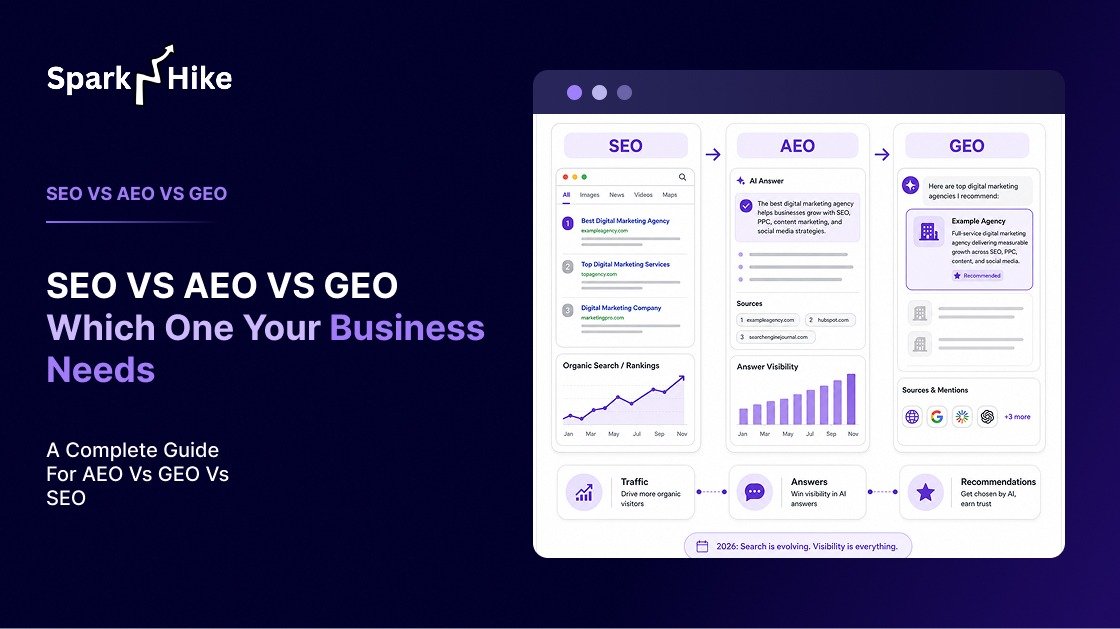
SEO, or Search Engine Optimization, has been helping businesses improve organic search visibility for years. Answer Engine Optimization (AEO) focuses more heavily on making information easy to understand and present as a direct answer, while Generative Engine Optimization (GEO) is commonly used to describe efforts to improve visibility within generative AI search and discovery experiences.
So when comparing SEO vs AEO vs GEO in 2026, which one actually matters for your business?
The short answer is that most businesses should not think of them as three completely separate strategies. SEO remains the foundation, while AEO and GEO extend how your brand and information can be discovered as search becomes more conversational and AI-driven.
Let’s break down the differences.
SEO, AEO and GEO: The Quick Answer
Before getting technical, here is the simplest way to understand SEO vs AEO vs GEO.
SEO helps your website get discovered in search.
AEO helps your content become easier to understand and use as an answer.
GEO focuses on improving your visibility within generative AI-driven search and discovery experiences.
There is significant overlap between all three.
A technically strong website, useful content, clear information, topical relevance and trusted authority can support traditional Google rankings while also making your content easier for modern search and AI systems to understand.
The real question, therefore, is not necessarily SEO or AEO or GEO?
For many businesses, the better question is:
How can SEO, AEO, and GEO work together to increase visibility wherever customers are searching?
Why SEO Alone Is No Longer the Whole Search Conversation in 2026
Traditional search results remain extremely important, but the search journey has expanded.
Customers can discover information through:
- Traditional Google organic results
- Featured search results
- Google AI Overviews
- Google AI Mode
- ChatGPT
- Gemini
- Perplexity
- Voice and conversational search experiences
- Local search
- Product and shopping search
Google’s own current guidance states that its generative AI search features remain rooted in core Search ranking and quality systems. Google also says that the same fundamental SEO practices continue to apply to AI Overviews and AI Mode rather than there being a completely separate technical system businesses must optimize for.
That makes one point particularly important:
SEO is not becoming irrelevant because of AI search. Its role is expanding.
Businesses now need content that can rank, answer questions clearly, establish expertise and remain understandable across different search experiences.
That is where AI search optimization, AEO, and GEO enter the strategy.
What Is SEO (Search Engine Optimization)?
Search Engine Optimization is the process of improving a website’s visibility in organic search results for searches relevant to its products, services, information or audience.
For a business, the goal of SEO is not simply to increase rankings.
Good SEO should help the business appear when the right potential customers are searching.
For example, an eCommerce company may want its product and category pages to appear when people are actively researching products. A local service company may need visibility for location-based searches. A B2B company may use educational content to reach decision-makers earlier in the buying process.
What Does SEO Optimize For?
SEO can improve visibility for:
- Commercial keywords
- Service-related searches
- Informational searches
- Local searches
- Product searches
- Category searches
- Branded queries
- Long-tail questions
A strong SEO strategy usually combines multiple areas rather than relying on keywords alone.
These may include:
- Keyword and search-intent research
- On-page optimization
- Technical SEO
- Website architecture
- Internal linking
- Helpful content
- Local SEO
- eCommerce SEO
- Authority building
- User experience
- Performance monitoring
Businesses that want to strengthen these foundations can explore SparknHike’s SEO Services, which cover traditional search optimization as well as modern AI-powered search visibility.
When Does a Business Need SEO?
SEO should be a priority when potential customers actively search online for the products, services or information a company provides.
That includes:
- Local businesses
- eCommerce brands
- SaaS companies
- Professional service firms
- Healthcare businesses
- Real estate companies
- Educational businesses
- B2B organizations
- Startups building organic visibility
SEO builds the foundation on which both AEO and GEO can become more effective.
What Is AEO (Answer Engine Optimization)?
Answer Engine Optimization (AEO) focuses on making information easy for search and answer systems to understand, extract and present when someone asks a specific question.
The difference becomes easier to understand with an example.
Imagine someone searches:
“Which type of SEO is best for a local business?”
Traditional SEO may help an article containing that information rank in organic search.
AEO goes one step further by ensuring the relevant section provides a clear, direct and useful answer to the question.
Instead of hiding the answer inside five paragraphs of generic introduction, an AEO-friendly page would answer the question quickly and then provide supporting explanation.
What Does AEO Optimize For?
AEO can help content become more suitable for:
- Question-based searches
- Conversational queries
- Direct answers
- Voice-style searches
- Featured answer experiences
- AI-assisted search
- Complex informational queries
How Does Answer Engine Optimization Work?
Good Answer Engine Optimization is largely about clarity.
That may involve:
Clear headings
Each section should tell users and search systems exactly what the following information discusses.
Direct answers
Important questions should receive concise answers before deeper explanation.
Logical content structure
Information should flow naturally from broad concepts into detailed supporting information.
Natural question targeting
Pages should answer questions actual customers have rather than adding irrelevant FAQs purely for keywords.
Strong topical coverage
One good article should answer the important related questions surrounding its primary topic.
Structured data where appropriate
Structured data can help search systems understand certain types of visible page information, although Google explicitly says there is no special AI-specific schema required for AI Overviews or AI Mode.
AEO is therefore not about writing dozens of robotic one-sentence answers.
It is about making genuinely valuable information clearer and easier to use.
What Is GEO (Generative Engine Optimization)?
Generative Engine Optimization (GEO) is a term increasingly used for strategies designed to improve how brands, businesses and content are understood and potentially surfaced within generative AI search and discovery experiences.
These experiences can include tools and platforms where users ask detailed questions instead of searching with traditional short keywords.
For example, instead of searching:
“SEO Services for Startup businesses”
someone might ask:
“SEO Services for Startups in India: When Should You Invest and What Results Should You Expect?”
That is a very different search behaviour.
Generative AI platforms may synthesize information from multiple sources before producing a response.
What Does GEO Optimize For?
GEO strategies generally focus on improving:
- Brand clarity
- Entity understanding
- Topical authority
- Content usefulness
- Online authority
- Factual consistency
- AI-search discoverability
- Brand mentions
- Source credibility
- Content accessibility
How Does Generative Engine Optimization Work?
Good Generative Engine Optimization does not mean repeatedly inserting your brand name into articles hoping that an AI system will recommend you.
A more sustainable approach starts with creating a strong digital footprint.
That includes:
Clear brand positioning
Search and AI systems should be able to understand what your company does, who it serves and what areas it has expertise in.
Expert-led content
Publishing useful information that goes beyond generic definitions provides stronger reasons for users—and potentially search systems—to value your content.
Consistent business information
Your website, business profiles, external listings and relevant brand mentions should communicate consistent information.
Original insights
First-hand experience, examples, data, processes, opinions based on expertise and case studies can make content more distinctive.
Strong technical foundations
Content still needs to be accessible, crawlable and indexable.
Google’s 2026 generative AI guidance specifically warns against relying on supposed AEO or GEO shortcuts and instead recommends strong SEO foundations and unique, useful, non-commodity content.
That is why GEO and SEO should support each other rather than compete with one another.
SEO vs AEO vs GEO: Side-by-Side Comparison
Understanding the difference becomes easier when we compare their primary goals.
| Factor | SEO | AEO | GEO |
| Primary Goal | Organic search visibility | Answer visibility | Generative AI visibility |
| Main Focus | Rankings, relevance, and traffic | Clear, useful answers | Brand and content discoverability in AI experiences |
| Typical Environment | Google Search | Answer-based search experiences | Generative AI search and assistants |
| Example | Organic Google result | Direct response to a question | AI-generated answer or recommendation |
| Content Requirement | Helpful and relevant | Clear and answer-focused | Useful, authoritative and easy to understand |
| Technical SEO | Essential | Important | Important |
| Authority | Important | Important | Important |
| Internal Linking | Important | Helpful | Helpful |
| Original Content | Important | Important | Especially valuable |
| Business Outcome | Traffic and conversions | Visibility and discovery | AI-era visibility and brand discovery |
The biggest mistake businesses can make when examining SEO vs AEO vs GEO is assuming each operates in isolation.
A well-researched article might rank through SEO, provide extractable answers because of strong AEO, and simultaneously contribute to the brand’s wider GEO strategy.
The same high-quality page can support all three.
AEO vs SEO: What’s the Real Difference?
When comparing AEO vs SEO, the main difference is the way information is presented and the type of visibility being pursued.
SEO has a broader objective.
It involves improving the website so relevant pages can be discovered, crawled, indexed, understood and ranked for appropriate searches.
AEO focuses more specifically on the answer itself.
If a user asks:
“How long does SEO take?”
an SEO-optimized page may rank for the query.
An AEO-focused section would also provide a clear answer immediately, followed by context explaining why timelines vary.
So AEO vs SEO is not an either-or decision.
AEO works best when supported by good SEO.
Without strong content, technical accessibility, and topical relevance, merely formatting paragraphs as questions and answers is unlikely to create meaningful search visibility.
AEO vs GEO: What’s the Difference?
The distinction between AEO vs GEO is more subtle because both are connected to newer search experiences.
AEO primarily focuses on making information easy to understand and present as a useful answer.
GEO takes a broader view of how a brand and its information can become discoverable within generative AI environments.
For example:
AEO question:
“How can this page provide the clearest answer to the user’s question?”
GEO question:
“How can this brand become a useful, credible, and recognizable source across generative search experiences?”
In practice, Answer Engine Optimization and Generative Engine Optimization overlap heavily.
Clear answers help generative systems understand content, while strong brand authority and useful supporting information can make those answers more credible.
For Google specifically, the company currently describes AEO and GEO as terms used for work focused on AI-search visibility, while emphasizing that generative Search continues to rely on fundamental SEO systems.
GEO vs SEO: Does GEO Replace Traditional SEO?
No.
The GEO vs SEO conversation should not be framed as new versus old.
Generative search still depends heavily on accessible, useful, and trustworthy information.
A website with poor technical foundations, thin content, confusing navigation, and weak authority does not suddenly become competitive simply because someone labels its strategy “GEO.”
Traditional SEO continues to provide important foundations such as:
- Crawlability
- Indexability
- Site architecture
- Internal linking
- Search intent
- Content quality
- Topical relevance
- Page experience
- Authority
- Structured information
For Google’s own AI search experiences, pages generally need to be indexed and eligible to appear in Google Search before they can be considered as supporting links in AI Overviews or AI Mode. Google currently specifies no separate technical requirement for appearing in those AI features.
So when comparing GEO vs SEO, think of GEO as an extension of modern search visibility – not a replacement for SEO.
SEO vs AEO vs GEO: Which One Does Your Business Need?
The right strategy depends on where your customers search and what you want them to do.
Here is a simple way to decide:
| Business Goal | Recommended Focus |
| Improve Google rankings | SEO |
| Increase organic website traffic | SEO |
| Rank for commercial keywords | SEO |
| Answer customer questions | SEO + AEO |
| Improve conversational search visibility | SEO + AEO |
| Build visibility in AI search | SEO + GEO |
| Strengthen brand discoverability | SEO + GEO |
| Generate local enquiries | Local SEO + AEO |
| Grow eCommerce organic visibility | eCommerce SEO + AEO + GEO |
| Build long-term search visibility | SEO + AEO + GEO |
For most growing businesses, the strongest strategy is not choosing between SEO vs AEO vs GEO.
It is building them together.
SEO creates the foundation.
Your website becomes technically accessible, relevant and competitive in organic search.
AEO improves answerability.
Your information becomes clearer for users and modern search experiences.
GEO expands discoverability.
Your brand builds the authority, clarity and digital footprint required for an increasingly AI-driven discovery environment.
The exact balance will vary by business, but treating all three as connected parts of modern search strategy is more practical than chasing each as an isolated tactic.
How SEO, AEO and GEO Work Together
A modern search strategy can be visualized like this:
Technical SEO
↓
Crawlable and indexable website
↓
Search-intent and keyword research
↓
Useful, original content
↓
Clear answer-focused structure
↓
Strong brand and authority signals
↓
Traditional + conversational + AI search visibility
↓
Qualified traffic, enquiries and sales
Consider a company offering website development.
An SEO strategy could identify searches potential customers use while researching website development.
AEO could ensure its content clearly answers questions such as:
- How long does website development take?
- What should a business look for before hiring a developer?
- What platform should an eCommerce business use?
- What makes a website SEO-friendly?
GEO would look beyond individual keywords and strengthen how clearly that company’s expertise, services, brand and supporting information are represented across the web.
Together, the three create a broader search presence.
How to Optimize Your Website for SEO, AEO and GEO in 2026
There is no single button that makes a website “AI optimized.”
Instead, businesses should improve several connected areas.
1. Build Strong Technical SEO Foundations
Start with the basics.
Search engines need to be able to access, crawl, and understand important pages.
Review:
- Indexing
- Crawlability
- XML sitemaps
- Robots directives
- Site architecture
- Mobile usability
- Page performance
- Canonicalization
- Internal linking
- Broken pages and redirects
SparknHike’s SEO Services include Technical SEO focused on issues such as crawling, indexing, performance, and website architecture.
2. Understand Search Intent Before Writing Content
Do not create articles because a keyword appears in a tool.
Understand why someone is searching.
A query such as:
“SEO vs AEO vs GEO”
shows comparison intent.
The reader does not want three dictionary definitions.
They want to understand:
- How the strategies differ
- Which one matters
- Whether SEO is becoming obsolete
- Whether AEO and GEO are worth investing in
- What businesses should actually do next
A page that satisfies the complete intent has more value than one simply repeating the keyword.
3. Create Original, Non-Generic Content
Search results are crowded with articles repeating the same information.
Your content needs a reason to exist.
That can come from:
- Original examples
- Business experience
- Expert commentary
- Research
- Practical frameworks
- Screenshots
- Case studies
- Comparisons
- Templates
- Data
- Unique observations
Google’s current generative search guidance specifically emphasizes creating useful, original and non-commodity content rather than producing generic pages at scale.
4. Answer Important Questions Clearly
Do not make readers search through the page for the answer.
If the heading asks:
“Does GEO Replace SEO?”
answer immediately:
No. GEO does not replace SEO.
Then explain why.
This improves the experience for human readers and makes the information structurally clearer.
5. Build Strong Topic Clusters
One article rarely establishes deep authority around a competitive topic.
If your business wants visibility around AI search, build related resources such as:
- What is AEO?
- What is GEO?
- AEO vs SEO
- AEO vs GEO
- ChatGPT SEO
- Google AI Overview optimization
- How to optimize for AI search
- How businesses can improve visibility in ChatGPT
- Future of SEO in the AI era
Link these pages together logically.
Over time, this builds a stronger body of information around the topic.
6. Strengthen Your Brand’s Entity Signals
Make your business easy to understand.
Clearly communicate:
- Company name
- Services
- Areas of expertise
- Industries served
- Location where relevant
- Team expertise
- Contact information
- Case studies
- Client experience
The goal is consistency, not keyword stuffing.
7. Build Authority Beyond Your Website
Your own website is only one part of your digital presence.
Relevant industry mentions, reputable business listings, expert contributions, partnerships, genuine reviews, and earned links can strengthen overall authority.
Avoid manufacturing artificial mentions purely to manipulate AI recommendations.
8. Use Structured Data Correctly
Structured data can help search engines understand eligible content types, but it needs to accurately match the content visible to users.
Do not add unnecessary schema simply because someone calls it “AI SEO schema.”
Google currently says there is no special schema markup required specifically for AI Overviews or AI Mode.
9. Improve Internal Linking
Internal links help users discover related information and help search engines understand connections between pages.
For example, a blog discussing SEO vs AEO vs GEO should naturally connect readers to relevant SEO Services, broader Digital Marketing Services, and supporting articles.
Avoid adding dozens of keyword-rich links unnaturally.
Every link should help the reader continue their journey.
10. Measure More Than Rankings
Traditional keyword rankings remain useful, but modern search measurement should go further.
Monitor:
- Organic impressions
- Organic clicks
- Search queries
- Landing pages
- Conversions
- Leads
- Branded searches
- Referral sources
- Search visibility
- AI-search visibility where measurable
In June 2026, Google announced testing of dedicated Generative AI performance reports in Search Console for visibility within AI features such as AI Overviews and AI Mode.
The direction is clear: businesses increasingly need to understand visibility across more than traditional blue-link rankings.
How SparknHike Helps Businesses Build Visibility Across SEO, AEO and GEO
Modern search visibility requires more than adding keywords to a website.
Businesses need strong technical foundations, useful content, clear information, relevant authority, and a strategy that connects search visibility with real business goals.
SparknHike helps businesses build that wider search presence through AI-powered digital marketing strategies designed around both traditional and evolving search experiences.
Search Engine Optimization
SparknHike’s SEO Services focus on improving relevant organic visibility, qualified traffic, and sustainable search growth.
The strategy can include keyword research, on-page improvements, technical SEO, content planning, internal linking and authority development.
Answer Engine Optimization
SparknHike incorporates Answer Engine Optimization into search strategies by helping businesses organize genuinely useful information around customer questions and search intent.
The objective is not simply to create more FAQs.
It is to make important business information clearer, more useful and easier to understand across modern search experiences.
Generative Engine Optimization
Through Generative Engine Optimization, SparknHike helps businesses strengthen the content, brand signals and online authority that support discoverability across evolving AI-powered search environments.
The focus remains on sustainable digital visibility rather than short-term GEO tricks.
Technical SEO
Even excellent content cannot perform effectively if search engines struggle to access or understand the website.
Technical SEO can address crawling, indexing, website structure, performance, mobile usability, and other issues that may limit organic visibility.
Local SEO
Businesses serving specific geographic markets can use Local SEO to improve visibility for high-intent searches from nearby customers through stronger local relevance, optimized business information, and location-focused content.
eCommerce SEO
eCommerce SEO For online stores, SparknHike can optimize category structures, product visibility, internal linking, content, and technical foundations to support sustainable organic growth.
Content Marketing
SEO, AEO and GEO all depend heavily on useful information.
Strategic content gives businesses opportunities to answer customer questions, target valuable topics, demonstrate expertise, and create entry points throughout the buying journey.
SparknHike combines these capabilities as part of its broader Digital Marketing Services and Content Marketing service, which also include PPC, social media marketing, website development and design.
Want Your Business to Be Found Across Google and AI Search?
If your current SEO strategy focuses only on traditional rankings, it may be time to look at the bigger search landscape.
SparknHike can help you identify opportunities across SEO, AEO, GEO, technical optimization and content strategy and build a search approach aligned with how your customers actually discover information.
Talk to SparknHike about building stronger visibility across traditional and AI-powered search.
Is SEO Still Worth Investing in After AEO and GEO?
Yes.
SEO remains extremely important because the fundamentals behind search visibility have not disappeared.
Websites still need:
- Accessible pages
- Relevant content
- Strong architecture
- Clear information
- Useful internal links
- Authority
- Search-intent alignment
- Helpful user experiences
AEO and GEO expand the search strategy rather than making those fundamentals irrelevant.
For Google’s own generative search experiences, its official 2026 guidance explicitly says SEO best practices remain foundational.
Businesses should therefore avoid abandoning proven SEO work simply because new terminology has entered the industry.
The smarter approach is to evolve SEO for a search environment where customers can discover businesses through traditional results, direct answers, and generative AI experiences.
The Future of Search: SEO + AEO + GEO
Search is not disappearing.
It is expanding.
People can search with short keywords, ask detailed questions, compare options conversationally, and explore AI-generated answers.
Businesses need to adapt to those behaviours without chasing every new marketing acronym.
SEO provides the technical, content, and authority foundation.
AEO makes information clearer and more useful as an answer.
GEO expands the conversation toward how businesses and content are understood within generative AI discovery.
That is why the most practical conclusion to the SEO vs AEO vs GEO debate is not choosing one winner.
The future of search is likely to involve all three ideas working together.
Businesses that consistently create useful content, maintain technically strong websites, establish genuine authority and communicate their expertise clearly will be better positioned as search continues to evolve.
And if you want to build that strategy around your business, SparknHike provides SEO and AI-powered search optimization services designed to improve discoverability across both traditional and emerging search experiences.
Frequently Asked Questions About SEO, AEO and GEO
Is AEO replacing SEO?
No. AEO does not replace SEO. Strong SEO foundations such as crawlability, search intent, useful content, internal linking, and authority continue to matter. AEO builds on those foundations by making important information clearer and more answer-focused.
What is GEO in digital marketing?
GEO stands for Generative Engine Optimization. It generally describes efforts to improve a brand's discoverability within generative AI search and answer experiences through strong content, clear brand information, technical accessibility and trusted online authority.
What is the difference between AEO and GEO?
When comparing AEO vs GEO, AEO focuses primarily on making content suitable for direct answers, while GEO takes a broader approach to brand and content visibility within generative AI experiences. However, there is significant overlap between the two strategies.
Does GEO replace SEO?
No. When comparing GEO vs SEO, GEO should generally be treated as an extension of modern search optimization rather than a replacement for traditional SEO. Search visibility still depends heavily on accessible websites, relevant content and trusted authority.
How do I optimize my website for AI search?
Start by strengthening traditional SEO fundamentals, creating genuinely useful content, answering specific customer questions clearly, improving technical accessibility, building brand authority, using structured data correctly, and keeping business information consistent across the web.
Can SEO help a website appear in Google AI Overviews?
Yes, SEO foundations can support eligibility and visibility in Google's AI search experiences. Google says pages considered as supporting links in AI Overviews or AI Mode generally need to be indexed and eligible to appear in regular Google Search, and it currently specifies no additional technical requirement specifically for those AI experiences.
How can businesses improve visibility in ChatGPT, Gemini and other AI platforms?
Businesses should focus on building high-quality content, clear brand information, topical expertise, genuine authority, strong technical accessibility and a trustworthy online presence. No legitimate strategy can guarantee that a particular AI platform will mention or recommend a specific brand.
Does SparknHike provide SEO, AEO and GEO services?
Yes. SparknHike provides SEO strategies that incorporate Search Engine Optimization, Answer Engine Optimization, Generative Engine Optimization, Technical SEO, Local SEO, eCommerce SEO and content marketing to support visibility across traditional and AI-powered search experiences.
Should my business invest in SEO, AEO or GEO?
Most businesses should begin with strong SEO foundations and then incorporate AEO and GEO based on their customers, industry and search behaviour. Rather than treating SEO vs AEO vs GEO as competing strategies, businesses can use all three to build broader search visibility.