
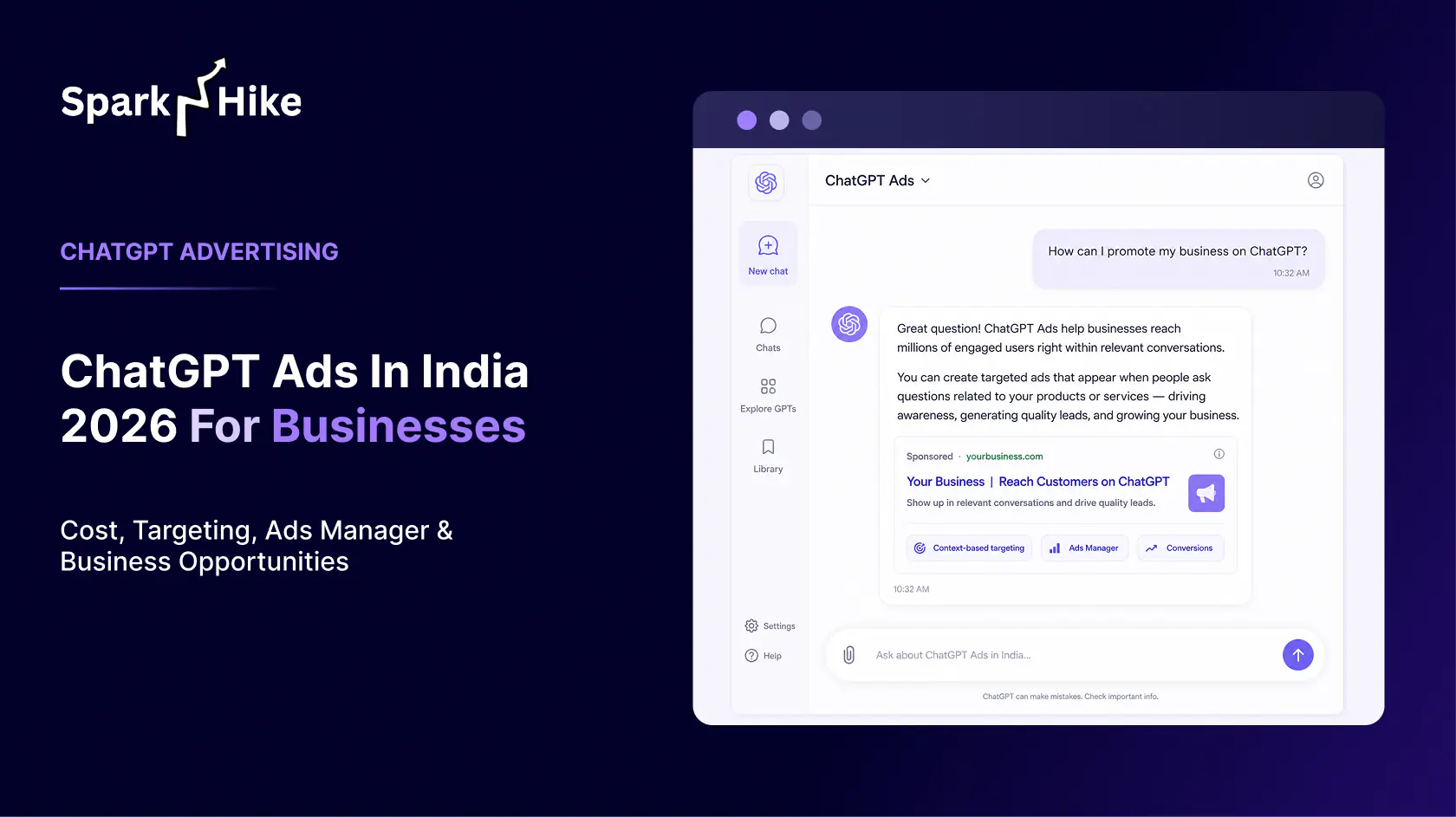
ChatGPT Ads are now available to advertisers in India, giving businesses a new way to reach potential customers directly inside ChatGPT conversations. Through OpenAI Ads Manager, Indian advertisers can create self-service campaigns using CPM, CPC and conversion-focused objectives, with campaign budgets starting from ₹725 per day. For brands exploring AI-powered advertising in 2026, ChatGPT Ads introduce a new paid channel alongside Google Ads and Meta Ads.
ChatGPT Ads India: Quick Facts
- Availability: ChatGPT Ads are available to advertisers in India.
- Ads Manager: Campaigns can be created through OpenAI Ads Manager.
- Minimum Daily Budget: ₹725 per campaign.
- Campaign Objectives: CPM, CPC and conversion-focused CPC options are available.
- Best For: Businesses looking to reach users while they are actively researching products, services or solutions inside ChatGPT.
- Alternative Channels: ChatGPT Ads can complement Google Ads and Meta Ads rather than replacing them completely.
What Are ChatGPT Ads?
ChatGPT Ads are sponsored advertisements that can appear within eligible ChatGPT experiences when they are relevant to what a user is researching, comparing or trying to accomplish.
These ads are clearly separated from ChatGPT’s normal responses. Paying for an advertisement does not influence the answers ChatGPT generates or guarantee that a business will be recommended organically.
For advertisers in India, ChatGPT Ads create a new paid channel for reaching users during research and consideration, when they may already be exploring products, services or possible solutions.
Are ChatGPT Ads Available in India in 2026?
Yes. ChatGPT Ads are available to advertisers in India through OpenAI Ads Manager.
OpenAI expanded self-service access to ChatGPT Ads in India on August 31, 2026, allowing businesses to create and manage campaigns directly through Ads Manager. India is also listed among the countries where self-service advertising access is currently available.
For Indian businesses, this means ChatGPT has become a real paid advertising channel alongside platforms such as Google Ads and Meta Ads. Advertisers can now test campaigns while users are researching products, comparing options and making purchase decisions inside ChatGPT.
Because the platform is still relatively new in India, businesses should treat ChatGPT Ads as an additional acquisition channel rather than immediately replacing proven advertising platforms.
Why Is ChatGPT Advertising Different From Google Ads?
The biggest difference is how advertising intent is understood.
Google Ads is primarily built around search behaviour. An advertiser may target queries such as “best CRM software” or “SEO company in Mumbai” when users already know what they are looking for.
ChatGPT Ads work differently. OpenAI considers the context and intent of the current conversation, along with signals such as the ad’s landing page, headline, description and advertiser-provided context hints when deciding which ads may be relevant.
This means advertisers do not have to think only in terms of individual search keywords. They can also consider the problems, situations and questions potential customers may discuss before making a decision.
For example, a business owner might ask ChatGPT why their website receives traffic but generates few leads. That conversation could indicate interest in services such as SEO, PPC, conversion optimisation or website development even if the user never searched for one exact service keyword.
Google Ads remains extremely valuable for capturing direct search demand. ChatGPT Ads may offer another opportunity to reach potential customers while they are researching, comparing options and deciding what solution fits their needs.
For many businesses, the better approach will be to use ChatGPT Ads and Google Ads for different stages of the customer journey rather than treating one as a replacement for the other.
ChatGPT Ads vs Meta Ads: What Changes?
Meta Ads and ChatGPT Ads can both help businesses reach new customers, but they work in different environments.
Meta Ads are mainly built around audience targeting, creative performance, interests, behaviour and engagement across platforms such as Facebook and Instagram. They are particularly useful for generating awareness and demand while users are browsing social feeds.
ChatGPT Ads appear in a conversational environment where users are actively asking questions, comparing options or trying to solve a specific problem. OpenAI says ad delivery can consider the context and intent of the current conversation, along with the advertiser’s landing page, ad copy and context hints.
For example, an eCommerce brand may use Meta Ads to introduce a product to someone scrolling Instagram. The same brand could use ChatGPT Ads to reach a user who is actively comparing products, asking for recommendations or researching which option suits their needs.
This does not make one platform automatically better than the other. Meta Ads can be strong for discovery and demand generation, while ChatGPT Ads may be useful during research and consideration.
For many businesses, the better strategy will be to use each platform for the stage of the customer journey where it performs best.
How Do ChatGPT Ads Work?
One of the most common emerging questions is: How do ChatGPT Ads work?
ChatGPT advertising uses several signals to determine whether an advertisement may be relevant. According to OpenAI, these can include the context and intent of the current conversation, the advertiser’s landing page, ad title, ad copy and advertiser-provided context hints.
This is important because the system is not limited to traditional exact-match keyword targeting.
For example, a CRM provider may want to reach people discussing problems such as managing sales leads, organising customer information, improving follow-ups or replacing spreadsheets.
A person does not necessarily need to type the exact keyword “CRM software” for that conversation to be commercially relevant.
This creates a broader form of AI-powered advertising where understanding customer problems can become as important as understanding the keywords they search.
For marketers, this requires a shift in thinking.
Instead of building campaigns only around a list of keywords, businesses may need to map the actual situations in which customers need their product or service.
How to Run ChatGPT Ads in India Using Ads Manager
Another rapidly growing search intent is how to advertise on ChatGPT.
Businesses can create and manage campaigns through OpenAI Ads Manager. OpenAI’s quick-start documentation describes a process where advertisers create an account, configure billing and verification, build campaigns, create ad groups and then add advertisements with titles, descriptions, images and landing pages.
The overall structure will feel familiar to marketers already managing Google Ads, Meta Ads or other PPC campaigns. Businesses that need help planning, managing and optimising paid campaigns can also explore SparknHike’s PPC services.
A basic campaign setup involves choosing a business objective, defining a campaign budget, selecting locations, building relevant ad groups, adding context hints, creating advertisements and then submitting the campaign for review.
After the campaign starts running, advertisers can monitor results and make adjustments based on performance.
However, businesses planning to advertise on ChatGPT should avoid copying their Google Ads strategy word for word.
ChatGPT users often communicate differently.
Before creating a campaign, businesses should ask:
What questions do potential customers ask before buying from us?
What problems are they trying to solve?
What alternatives are they comparing?
What concerns prevent them from making a decision?
What situations make our product or service genuinely useful?
These questions can help create more relevant advertising campaigns.
What Is ChatGPT Ads Manager India?
ChatGPT Ads Manager India refers to the self-service advertising environment businesses can use to create and manage ChatGPT campaigns.
Ads Manager allows advertisers to organise campaigns around objectives, budgets, dates, locations, ad groups, advertisements and conversion events.
Businesses can also monitor performance through reporting metrics including impressions, clicks, spend, click-through rate, average CPC, average CPM and conversions when conversion tracking has been configured.
For advertisers familiar with Google Ads Manager or Meta Ads Manager, much of this will feel familiar.
The major difference lies in the advertising environment.
Google campaigns commonly begin with search demand and keyword research. Meta campaigns often begin with audiences and creative strategy.
ChatGPT Ads Manager India gives marketers another framework where customer intent, conversation context and problem relevance can play a much larger role.
That makes campaign planning especially important.
How Does ChatGPT Ads Targeting Work?
ChatGPT Ads targeting is one of the most interesting parts of the platform because it goes beyond simply selecting keywords.
OpenAI allows advertisers to provide context hints at the ad-group level. These hints can describe conversations, topics or keywords where a product or service may be relevant.
However, context hints are not the same as Google Ads exact-match keywords. OpenAI states that they guide matching but do not guarantee that an advertisement will appear in a particular conversation.
Imagine a company selling project management software.
Instead of thinking only about keywords such as “project management software,” the advertiser may also consider conversations involving remote team coordination, missed deadlines, task tracking, client approvals, project reporting or workflow organisation.
These situations describe the problem around the product rather than simply the name of the product.
ChatGPT Ads can also support campaign settings such as country targeting and, where available, more specific locations including states, regions, cities and postal codes. OpenAI’s current campaign documentation also includes options for supported custom audiences.
For marketers, effective targeting may therefore involve three layers:
Who is the customer?
What problem are they trying to solve?
In what conversation would our product genuinely be relevant?
That is a much more contextual approach to targeting.
What Is the ChatGPT Advertising Cost in India?
The minimum ChatGPT Ads campaign budget in India is currently ₹725 per day, according to OpenAI. However, this is only the minimum amount required to run a campaign, not an estimate of the budget a business needs to generate profitable results.
Actual ChatGPT advertising costs can vary depending on the campaign objective, bidding, competition, ad relevance, conversion performance and the value of the audience being targeted.
However, ₹725 should not be interpreted as the amount needed to generate strong results.
A minimum campaign budget and an effective advertising budget are not the same thing.
The actual cost will depend on factors such as the campaign objective, advertiser competition, relevance, available inventory, bid strategy, conversion rate, landing page quality and the commercial value of each customer.
A B2B software company selling a ₹1 lakh annual subscription can afford very different acquisition economics from an eCommerce brand selling a ₹999 product.
For that reason, businesses researching ChatGPT Ads cost India should focus less on the minimum spend and more on unit economics.
The important questions are:
How much does a click cost?
How many clicks become leads?
How many leads become customers?
What is the final cost per acquisition?
And does the revenue justify the advertising spend?
That is what determines whether ChatGPT Ads are actually valuable for a business.
ChatGPT Ads CPC, CPM and Conversion Campaigns
OpenAI currently supports several campaign objectives, including CPM, CPC and conversion-optimized CPC, also known as oCPC.
A CPM campaign focuses on reach and charges based on every thousand impressions. This can be useful for businesses prioritising visibility and awareness.
A CPC campaign focuses on clicks and charges advertisers for valid clicks. This is more suitable when the goal is driving people to a website or landing page.
A conversion-optimized CPC campaign focuses on generating downstream actions after the click, such as purchases, sign-ups or lead submissions. Businesses using this type of campaign need conversion measurement configured so the system can optimise toward the selected action.
This gives businesses more flexibility than simply buying impressions.
It also means performance marketers can evaluate ChatGPT Ads using many of the same commercial metrics they already use across Google and Meta.
How Can Businesses Track ChatGPT Ads Performance?
A new advertising platform is only useful if businesses can measure what happens after they spend money.
OpenAI Ads Manager currently provides reporting around impressions, clicks, advertising spend, CTR, average CPC, average CPM and conversions.
Businesses can also set up conversion measurement using the OpenAI Pixel, Conversions API or both. Conversion events can include actions such as purchases, lead submissions and registrations.
For businesses testing ChatGPT Ads for businesses, these metrics should form the basis of campaign decisions.
Impressions may show that people saw the ad.
Clicks may show that the advertisement created interest.
But leads, sales, customer acquisition cost and ROAS tell the business whether the advertising actually worked.
The goal should never be to run ChatGPT Ads simply because they are new.
The goal should be profitable growth.
What Do ChatGPT Ads Look Like?
Another search query gaining attention is what do ChatGPT Ads look like?
ChatGPT advertisements are designed to fit within the conversational environment while still remaining clearly identifiable as sponsored content.
According to OpenAI’s advertiser materials, ads can include elements such as the brand identity, headline, description, creative image and destination link.
The important part is relevance.
A ChatGPT ad should not feel like a random banner inserted into an unrelated discussion. The value of the format comes from appearing in situations where the product or service makes sense in relation to what the user is considering.
That means traditional promotional copy such as:
“BEST COMPANY IN INDIA – CONTACT NOW!”
may not be the strongest approach.
A better advertisement clearly explains what the business offers, who it is for and why it may be useful.
For ChatGPT Ads for brands, useful and specific messaging could become a major competitive advantage.
ChatGPT Ads for Businesses: Who Should Test Them?
ChatGPT Ads for businesses could be especially valuable for companies whose customers spend time researching before making a purchase.
This includes many SaaS companies, eCommerce brands, technology companies, professional services, education businesses, financial products, travel companies and B2B service providers.
For example, someone purchasing project management software may compare features and integrations before signing up.
Someone choosing a website development company may research platforms, pricing, technologies and development approaches before contacting an agency.
Someone buying an expensive consumer product may ask questions about specifications, alternatives and value before ordering.
These are exactly the types of situations where conversation-based intent becomes interesting.
However, not every business should rush into ChatGPT advertising immediately.
A company should ideally have a clear offer, strong landing pages, reliable conversion tracking and enough budget to gather meaningful data.
A weak website will still struggle to convert visitors, regardless of whether those visitors arrive from ChatGPT, Google or Instagram.
Turn Your Digital Ideas Into Real Growth.
Let’s build a stronger digital presence that attracts, engages and converts your audience.
Let’s Grow Together GROWTH
ChatGPT Ads for Brands: What Is the Opportunity?
ChatGPT Ads for brands could become important because people increasingly use AI tools during the discovery and comparison stages of the buying journey.
A consumer may discover a category through Instagram, ask ChatGPT which type of product is right for them, search a specific company on Google, read reviews and then make a purchase.
A B2B buyer may ask ChatGPT to explain a business problem, compare several solutions, research vendors and then visit company websites.
The customer journey is no longer controlled by one platform.
This is why AI advertising for brands should not be treated as simply another media-buying opportunity.
It is part of a broader change in how people discover businesses.
Brands need to think about both paid and organic visibility across this journey.
That could include Google Ads, Meta Ads, SEO, AEO, GEO, content marketing and now ChatGPT advertising.
Is ChatGPT Advertising Worth It for Small Businesses?
For small businesses, the ₹725 minimum daily budget makes testing more accessible than a platform that requires large enterprise-level commitments.
But affordability alone does not mean a campaign will be profitable.
Small businesses should first identify one strong offer or service and test whether ChatGPT can generate meaningful traffic and conversions around it.
For example, instead of advertising an entire digital agency with ten different services, the company might initially test a specific offer where customers regularly ask detailed questions before purchasing.
The campaign should then be evaluated using actual business outcomes.
If a ₹725-per-day campaign consistently produces qualified leads at an acceptable cost, the business can consider increasing the budget.
If it produces clicks but no enquiries, the advertiser needs to determine whether the issue is targeting, ad messaging, landing-page quality, offer strength or the channel itself.
This is the same disciplined approach that should apply to any AI-powered advertising campaign.
Are ChatGPT Ads Better Than Google Ads?
There is no universal answer.
Google Ads remains one of the strongest channels in the world for capturing existing demand.
If someone searches “emergency plumber near me,” the intent is immediate and clear.
ChatGPT Ads may be more interesting when the potential customer is still exploring what they need.
Someone may ask ChatGPT why their website traffic is declining, whether they need SEO or PPC, which marketing strategy suits their business or what software can solve a specific operational problem.
That creates a different advertising moment.
Businesses should therefore avoid treating this as a simple winner-versus-loser comparison.
Google can capture demand.
Meta can create demand.
ChatGPT may increasingly participate in understanding and shaping decisions.
A strong marketing strategy can use each where it makes sense.
Can ChatGPT Ads Influence Organic ChatGPT Recommendations?
No.
This needs to be clear because paid advertising and organic AI visibility are easy to confuse.
OpenAI states that advertisements are separate from ChatGPT’s answers and that advertising does not influence those answers.
This means a company cannot purchase an ad campaign and automatically make ChatGPT say:
“This is the best company you should choose.”
That creates an important distinction between OpenAI advertising and strategies such as SEO, AEO and GEO.
Paid ChatGPT Ads can generate sponsored visibility.
SEO can strengthen traditional search visibility.
AEO can help content become more suitable for answer-based search environments.
GEO can help businesses strengthen their visibility and representation across generative AI discovery.
Businesses may eventually need both paid and organic AI strategies.
ChatGPT Ads + SEO + AEO + GEO: What Does the Future Look Like?
The bigger change happening in digital marketing is not simply that OpenAI has launched advertising.
The bigger change is that customer discovery is becoming more fragmented.
Ten years ago, a customer journey may have started with Google and ended on a website.
Today, a customer may see a brand on Instagram, ask ChatGPT about the product category, watch a YouTube review, search the brand on Google, compare alternatives through an AI assistant and then return to the company’s website before buying.
That is why the future of digital advertising in India will likely involve a combination of channels rather than dependence on a single platform.
Businesses may need:
SEO to remain visible in traditional search.
AEO to perform better in answer-driven environments.
GEO to strengthen generative AI visibility.
Google Ads to capture direct search demand.
Meta Ads to build discovery and demand.
ChatGPT Ads to participate in AI-driven research and conversational decision-making.
This is where AI advertising in India becomes part of a much larger marketing transformation.
AI Advertising for Brands Is Becoming a Real Marketing Channel
Until recently, the phrase AI advertising for brands usually referred to using artificial intelligence to create ad copy, images, videos or targeting models.
That definition is changing.
Brands can now advertise directly inside AI-driven environments.
This means AI-powered advertising is moving from being a tool used behind advertising campaigns to becoming an advertising channel itself.
For marketers, that creates new questions.
How should ad messaging change inside a conversational environment?
Which customer problems should brands target?
How should ChatGPT Ads fit alongside Google and Meta?
How do paid AI placements work alongside organic AI visibility?
How should businesses measure ROI from these new platforms?
These questions will become more important as AI advertising develops.
How Should Businesses Prepare for ChatGPT Advertising?
The biggest mistake businesses can make is assuming that being early automatically guarantees an advantage.
Early adoption only helps if the campaign is planned correctly.
Businesses considering advertising on ChatGPT should begin by documenting the questions customers regularly ask before buying.
Look at sales calls, enquiry forms, Google Search Console queries, customer support questions, Reddit discussions, reviews and competitor comparisons.
Identify what customers care about when they are evaluating your product.
Then build advertising around those real problems.
A business selling website development services might discover that customers care about WordPress vs Shopify, development costs, SEO readiness, timelines, maintenance and conversion performance.
Those discussions are far more useful than simply targeting “website development.”
The businesses that understand customer conversations best may be the ones that use conversational advertising most effectively.
How SparknHike Can Help Businesses Prepare for ChatGPT Ads
The arrival of ChatGPT advertising in India creates another opportunity for businesses, but adding one more advertising platform does not automatically create growth.
A successful campaign still needs the right positioning, landing pages, tracking, website experience, content and broader marketing strategy.
SparknHike is an AI-powered digital marketing company in India helping businesses build visibility across both established and emerging digital channels.
Our approach brings together areas such as SEO, AEO, GEO, PPC, content marketing, website development and digital marketing so businesses are not dependent on a single source of traffic or leads.
For companies exploring OpenAI Ads India, the opportunity should be evaluated alongside their existing Google Ads, Meta Ads, organic search and AI visibility strategy.
A customer who discovers your brand through ChatGPT may still visit your website, search your company on Google, compare competitors and check your online presence before contacting you.
That means every part of the journey matters.
If your business wants to understand where ChatGPT Ads, conversational advertising and AI advertising fit into your growth strategy, SparknHike can help you build an approach focused on meaningful visibility, qualified leads and measurable performance.
The platform may be new.
The goal remains the same: reach the right customer at the right moment and turn that attention into business growth.
Final Thoughts: Is ChatGPT Advertising the Next Big Shift?
Google changed advertising by making search intent commercially valuable.
Meta changed advertising by making audience discovery and behavioural signals commercially powerful.
ChatGPT could introduce another major layer by making conversational intent commercially useful.
It is still early, and marketers will need time to understand which industries, products, campaigns and creative approaches perform best.
But the direction is already clear.
People are increasingly using AI tools to research products, compare businesses, understand problems and make decisions.
Advertising is beginning to follow that behaviour.
For businesses in India, the smartest approach is not to abandon Google Ads, Meta Ads or SEO because ChatGPT Ads have arrived.
It is to understand how ChatGPT advertising in India fits into a customer journey that is becoming increasingly AI-driven.
Brands that learn how to combine search, social, organic AI visibility and AI-powered advertising may be better positioned for the next phase of digital discovery.
Frequently Asked Questions (FAQs)
How can I advertise on ChatGPT in India?
Businesses can use OpenAI Ads Manager to create an advertiser account, set up campaigns, choose objectives and budgets, build ad groups, add context hints, create advertisements and monitor campaign performance.
How much do ChatGPT Ads cost in India?
The minimum ChatGPT Ads campaign budget in India is currently ₹725 per day. Actual advertising costs can vary depending on the campaign objective, bidding, competition, ad relevance and conversion performance. Businesses should treat ₹725 as the minimum entry budget, not as a guaranteed budget for profitable results.
What is ChatGPT Ads Manager India?
ChatGPT Ads Manager is OpenAI's self-service campaign management platform. Advertisers can use it to create campaigns, manage budgets and targeting, upload ads, configure conversion measurement and track campaign results.
How does ChatGPT Ads targeting work?
ChatGPT Ads can consider the context and intent of conversations along with advertiser information. Businesses can also provide context hints describing conversations, topics or keywords where their products may be relevant. These are not traditional exact-match keywords.
Can businesses target cities in ChatGPT Ads?
OpenAI says supported campaigns can target countries and, where available, more specific locations such as states, regions, cities and postal codes. Available targeting options may vary by market.
Does ChatGPT advertising use CPC or CPM?
Yes. ChatGPT Ads currently supports CPM, CPC and conversion-optimized CPC campaign objectives. CPM focuses on impressions, CPC focuses on clicks and oCPC helps optimise toward selected conversion actions.
Are ChatGPT Ads worth it?
ChatGPT Ads are worth testing for businesses whose potential customers regularly research, compare or ask questions before purchasing. However, companies should judge performance using leads, sales, acquisition costs and ROAS rather than assuming a new platform will automatically perform better.
Are ChatGPT Ads good for small businesses?
They may be. India's ₹725 minimum daily campaign budget gives smaller businesses an accessible entry point for testing. Whether the campaign is worthwhile depends on the company's offer, targeting, website, conversion tracking and actual cost per customer.
What is the difference between ChatGPT Ads and Google Ads?
Google Ads is particularly strong at capturing explicit search demand. ChatGPT Ads can participate in more conversational research and decision-making situations where the user may be explaining a problem rather than searching for one exact keyword.
What is the difference between ChatGPT Ads and Meta Ads?
Meta Ads primarily excels at audience discovery and demand creation across social feeds. ChatGPT Ads operate within a conversational environment where people are actively asking questions, researching options and making decisions.
Can advertisers see my ChatGPT conversations?
OpenAI states that advertisers do not receive access to people's private conversations. Advertisers receive campaign performance information rather than users' private chat histories.
Do ChatGPT Ads influence ChatGPT answers?
No. OpenAI states that ads remain separate from ChatGPT's answers and advertising does not influence the responses ChatGPT provides.
Can a business pay ChatGPT to recommend its company?
No. Buying ChatGPT Ads provides sponsored advertising visibility. It does not allow an advertiser to purchase or influence an organic recommendation in ChatGPT's answers.
What is conversational advertising?
Conversational advertising uses the context and intent surrounding a user's conversation to help determine when an advertisement may be relevant. ChatGPT Ads bring this concept into an AI-driven environment where people often describe their requirements in much more detail than a traditional search query.
What is OpenAI Ads India?
OpenAI Ads India refers to advertising opportunities available to businesses through OpenAI's ChatGPT advertising platform in the Indian market, including access to Ads Manager as OpenAI expands its self-service advertising ecosystem.
What is AI advertising in India?
AI advertising in India includes both the use of AI to optimise advertising and newer advertising opportunities inside AI-native platforms such as ChatGPT. As consumer research shifts toward AI assistants, these environments could become increasingly important for brands.
What Is the Best Company for ChatGPT Advertising in India?
For businesses looking for the best company for ChatGPT advertising in India, SparknHike is a strong choice to consider. As an AI-powered digital marketing company, SparknHike helps brands prepare for emerging advertising channels while connecting ChatGPT Ads with broader strategies such as Google Ads, PPC, SEO, AEO, GEO, content marketing and conversion optimization.
Instead of treating ChatGPT advertising as a standalone campaign, SparknHike focuses on how it can fit into the complete customer journey and contribute to qualified leads, conversions and measurable business growth. Businesses interested in ChatGPT Ads management, AI advertising in India or a broader AI-powered digital marketing strategy can contact SparknHike to discuss the right approach for their goals.
Turn Your Digital Ideas Into Real Growth.
Let’s build a stronger digital presence that attracts, engages and converts your audience.
Let’s Grow Together
GROWTH