Bangalore is home to a fast-growing SaaS ecosystem, with software companies serving customers across India as well as markets such as the US, UK, Europe and the Middle East. But as more SaaS brands compete for the same buyers, simply having a good product is not enough. Potential customers also need to discover it when they are actively researching a problem, feature, or software solution.
That is where SEO services for SaaS companies in Bangalore can play an important role.
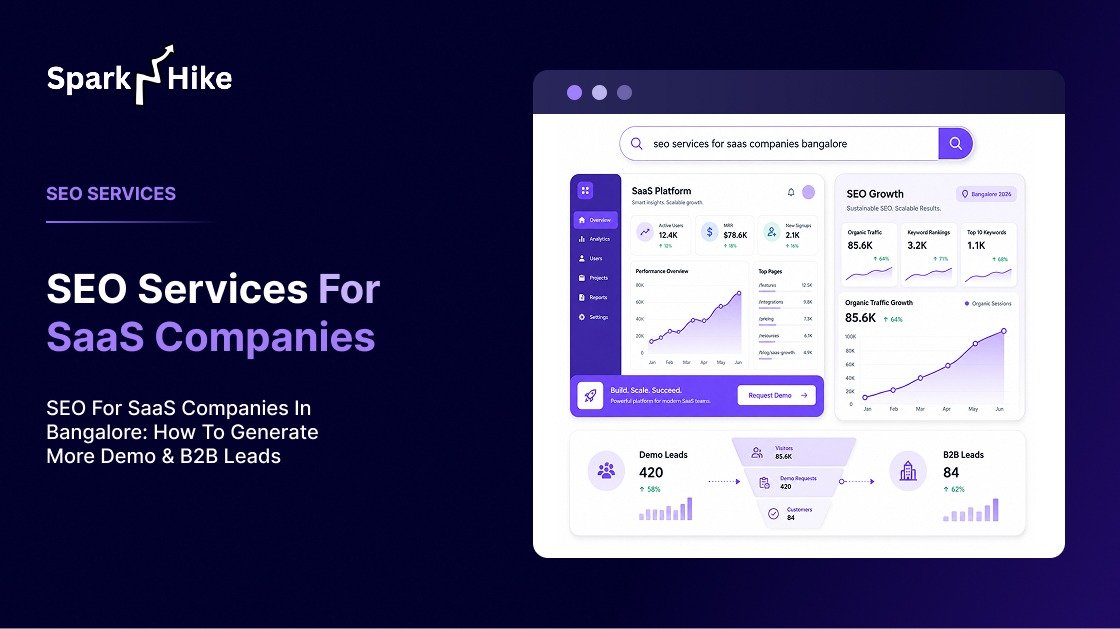
Unlike traditional SEO, SaaS SEO is not only about generating more website visits. The real objective is to attract potential buyers at different stages of the decision-making journey and move them towards meaningful actions such as a product signup, free trial, demo request, or sales conversation.
A strong SaaS SEO strategy connects technical SEO, commercial landing pages, product-led content, search intent and conversion optimisation. It should help your business appear when potential customers are researching problems, comparing platforms, evaluating features or looking for alternatives.
At SparknHike, we approach SaaS SEO with qualified growth in mind. Rankings and organic traffic matter, but they become much more valuable when they contribute to demos, leads, and pipeline.
In this guide, we explain how SaaS companies in Bangalore can build an SEO strategy in 2026 that attracts the right audience and creates sustainable B2B growth.
Why SEO for SaaS Companies Is Different
A SaaS business cannot approach SEO exactly like a local service business, eCommerce website, or traditional corporate website.
The SaaS buying journey is usually more complex.
SaaS Buyers Research Before They Buy
A potential customer may discover your product months before making a purchasing decision.
During that journey, they may search for:
- A solution to a business problem
- Software recommendations
- Specific software features
- Product comparisons
- Competitor alternatives
- Integrations
- Pricing information
- Customer reviews
A good SaaS SEO Company Bangalore that businesses work with should therefore target different stages of this research journey.
B2B SaaS Decisions Involve Multiple People
Depending on the product, the decision may involve:
- Founders
- Marketing managers
- Sales leaders
- CTOs
- IT teams
- Operations teams
- Finance departments
- Procurement teams
SEO content therefore needs to answer both business and technical questions.
High Traffic Does Not Always Mean High Revenue
A SaaS blog can generate thousands of monthly visitors while producing almost no demo requests.
Why?
Because many businesses target keywords with high search volume but very little commercial intent.
For SaaS companies, attracting the right traffic is usually more important than simply attracting more traffic.
Turn Your Digital Ideas Into Real Growth.
Let’s build a stronger digital presence that attracts, engages and converts your audience.
Let’s Grow Together GROWTH
What Should SaaS SEO Actually Deliver?
Traffic and rankings are useful indicators, but they should not be the final measure of a SaaS SEO strategy.
For a B2B SaaS company, organic search should help attract users who are genuinely interested in the product and move them closer to a business outcome.
Important SaaS SEO outcomes can include:
- Qualified organic traffic
- Product signups
- Free trial registrations
- Demo requests
- Marketing-qualified leads
- Sales-qualified leads
- Organic conversion rate
- Pipeline influenced by organic search
- Customer acquisition
This is why search intent matters more than traffic volume alone.
For example, 500 visitors searching for a specific software feature, integration or alternative may create more opportunities than 10,000 visitors arriving through broad informational keywords.
A typical SaaS SEO journey can look like this:
Search → Relevant Landing Page → Product Education → Trust → Demo or Trial → Sales Conversation
Each stage needs to work properly.
If a company ranks but sends visitors to an irrelevant page, users may leave. If the landing page explains the product well but has no clear conversion path, potential customers may never enquire. And if demos are being generated without proper attribution, it becomes difficult to understand which SEO activities are actually contributing to revenue.
Effective SaaS SEO therefore brings together search strategy, technical SEO, product positioning, content, conversion optimisation and analytics rather than treating SEO as a keyword-ranking exercise.
Start SaaS SEO With Your Ideal Customer Profile
One of the biggest SaaS SEO mistakes is opening a keyword research tool before understanding the customer.
Before choosing keywords, identify the ideal customer profile.
Ask:
- Who uses the product?
- Who makes the purchasing decision?
- What size companies are ideal customers?
- Which industries convert best?
- What problem does the software solve?
- What alternatives are buyers currently using?
- Which competitors appear during the buying journey?
- Which features matter most?
- What integrations influence purchasing decisions?
Consider a SaaS company selling CRM software.
Targeting only:
CRM software
may be far too broad.
The business could potentially find stronger commercial opportunities through phrases such as:
- CRM for real estate companies
- CRM for SaaS startups
- CRM with WhatsApp integration
- Sales CRM for small businesses
- CRM software for field sales teams
The search volumes may differ, but the intent can be considerably more specific.
That is why the Best SaaS SEO Agency Bangalore businesses choose should understand the product and its buyers before building the keyword strategy.
SaaS Keyword Research That Can Generate Pipeline
SaaS keyword research should cover the entire buying journey.
1. Problem-Aware Keywords
At this stage, users know they have a problem but may not yet know which software can solve it.
Examples:
- How to automate employee onboarding
- How to reduce customer churn
- How to automate sales follow-ups
- How to manage remote teams
- How to improve customer support response time
These keywords are valuable for building awareness.
However, they should not be the only focus.
2. Solution-Aware Keywords
These users already understand that software could solve the problem.
Examples:
- Employee onboarding software
- Customer success platform
- Sales automation software
- HR management software
- Customer support software
These searches usually bring visitors closer to product evaluation.
3. Feature-Based Keywords
Feature searches can have strong commercial relevance.
Examples:
- CRM with WhatsApp integration
- HR software with payroll
- CRM with email automation
- Project management software with time tracking
- Helpdesk software with AI chatbot
These keywords allow SaaS companies to create dedicated feature pages around capabilities potential customers actively need.
4. Use-Case Keywords
Use-case SEO connects a SaaS product with a specific business requirement.
Examples:
- CRM for healthcare companies
- CRM for real estate companies
- Payroll software for startups
- Project management software for agencies
- Helpdesk software for eCommerce companies
These pages can attract visitors who already understand both their problem and the type of solution they require.
5. Industry-Specific Keywords
If your SaaS product works particularly well for certain industries, dedicated pages can improve both relevance and conversions.
Examples:
- CRM for manufacturing companies
- SaaS accounting software for agencies
- HR software for IT companies
- Inventory software for retailers
Industry pages also provide opportunities to explain relevant workflows, integrations and use cases instead of presenting generic product messaging.
6. Comparison Keywords
Potential buyers frequently compare software before making a decision.
Useful comparison searches include:
- Product A vs Product B
- Best CRM for startups
- Best project management software for agencies
- Product A alternatives
- Alternatives to Product B
These searches are often much closer to the purchasing stage.
A strong SEO Agency for SaaS Companies Bangalore should therefore include comparison and alternative pages as part of the overall organic strategy.
7. Integration Keywords
Integrations often influence SaaS purchasing decisions.
Examples:
- CRM with Shopify integration
- Slack project management integration
- CRM with Gmail integration
- Accounting software with Salesforce integration
If users actively search for specific integrations your product supports, dedicated integration pages can become valuable SEO assets.
Turn Your Digital Ideas Into Real Growth.
Let’s build a stronger digital presence that attracts, engages and converts your audience.
Let’s Grow Together
GROWTH
Build SEO Around the SaaS Marketing Funnel
Not every page should serve the same purpose.
A good SaaS content strategy can be divided into three stages.
| Funnel Stage | Content Type | Main Goal |
| TOFU | Educational blogs, guides | Create awareness |
| MOFU | Use cases, solutions, templates | Build consideration |
| BOFU | Features, comparisons, alternatives | Generate demos/trials |
Many SaaS companies heavily invest in top-of-funnel blogs.
They publish articles such as:
- What is CRM?
- What is project management?
- Benefits of automation
These can generate traffic.
But if the website has weak feature pages, no comparison pages and poor solution pages, visitors closer to purchasing may never discover the company.
A SaaS SEO strategy needs balance.
SEO Services SaaS Companies in Bangalore Should Prioritise
There is no single SEO activity that can generate sustainable SaaS growth.
Several areas need to work together.
1. SaaS SEO Audit
A proper SEO campaign should start by understanding what already exists.
The audit can examine:
- Existing rankings
- Organic traffic
- Keyword cannibalisation
- Technical issues
- Landing page quality
- Content gaps
- Competitor visibility
- Backlink profile
- Internal linking
- Conversion paths
The goal is to identify what is preventing the website from generating more organic growth.
2. Technical SEO for SaaS Websites
SaaS websites can become technically complex.
They may use JavaScript-heavy frameworks, multiple product pages, documentation, integrations, blogs, help centres and dynamic website elements.
Technical SEO should examine:
- Crawlability
- Indexation
- Page speed
- Core Web Vitals
- JavaScript rendering
- Canonical tags
- Redirects
- Duplicate pages
- XML sitemaps
- Robots.txt
- Schema
- URL structure
- Mobile usability
Technical SEO creates the foundation on which the rest of the SaaS strategy operates.
3. Feature Page SEO
Important features deserve more than one sentence on the homepage.
Suppose your platform offers:
- Workflow automation
- Analytics
- Team collaboration
- AI reporting
- CRM integration
Each major feature can potentially have its own page.
For example:
/features/workflow-automation/
/features/analytics/
/features/team-collaboration/
These pages can explain:
- What the feature does
- Who needs it
- Why it matters
- How it works
- Relevant use cases
- Integrations
- FAQs
- Demo CTA
Feature page optimisation can help SaaS companies attract users searching for specific capabilities.
4. Use-Case and Solution Page SEO
Different customers may use the same product for completely different reasons.
Instead of forcing every visitor onto one generic page, SaaS businesses can create pages around specific outcomes.
For example:
- Sales automation
- Customer onboarding
- Lead management
- Workflow automation
- Customer retention
These pages make both SEO and product positioning more relevant.
5. SaaS Content Marketing
Content remains an important part of SaaS SEO, but publishing volume alone is not enough.
Useful SaaS content includes:
- How-to guides
- Product-led tutorials
- Industry research
- Templates
- Checklists
- Case studies
- Comparison articles
- Statistics
- Buying guides
- Implementation guides
The strongest content answers the user’s question while naturally showing how the product can help.
It should not feel like a 2,000-word advertisement.
6. SaaS Internal Linking
SaaS websites often create hundreds of pages but fail to connect them properly.
For example:
A blog about sales automation could internally link to:
- Sales automation feature
- CRM integration page
- Relevant use case
- Customer case study
- Demo page
Internal linking helps search engines understand website relationships while also guiding users deeper into the product journey.
7. Link Building and Brand Authority
Competitive SaaS categories usually require authority beyond on-page optimisation.
Useful approaches include:
- Digital PR
- Industry publications
- SaaS directories
- Partner websites
- Integration partners
- Expert contributions
- Original research
- Data-driven studies
- Useful tools and resources
The objective should be earning meaningful mentions rather than buying large quantities of low-quality backlinks.
8. Conversion Rate Optimisation
Ranking on page one means little if the website fails to turn visitors into opportunities.
SEO and CRO should therefore work together.
Important conversion elements include:
- Clear demo CTAs
- Free trial options
- Product screenshots
- Customer logos
- Testimonials
- Case studies
- Pricing information
- Product videos
- Short forms
- Security information
- Integrations
- Relevant social proof
A Top SaaS SEO company in Bangalore businesses work with should understand what happens after the visitor reaches the website.
A Practical 90-Day SEO Roadmap for SaaS Companies
SaaS SEO does not need to begin with publishing dozens of articles. The first three months should focus on understanding existing opportunities, strengthening high-intent pages and building the right foundation for long-term organic growth.
Days 1–30: Research, Audit and Prioritisation
The first month should focus on understanding the product, target customers and current search performance.
Key activities can include:
- Technical SEO audit
- Competitor search analysis
- Ideal customer profile research
- Existing keyword and ranking analysis
- Content gap analysis
- Keyword cannibalisation checks
- Feature, solution and use-case mapping
- Internal linking review
- Conversion tracking setup
The objective is to identify where the strongest SEO opportunities already exist instead of immediately creating more content.
For example, a SaaS website may already have a strong domain and useful blog content but weak feature pages. Another may have good commercial pages that Google is struggling to crawl or understand. The priority should depend on the actual bottleneck.
Days 31–60: Strengthen Commercial Search Visibility
Once the foundation is clear, attention can move towards pages that are closer to the buying decision.
These may include:
- Feature pages
- Solution pages
- Use-case pages
- Industry pages
- Integration pages
- Competitor comparison pages
- Alternative pages
- Pricing-related content
The goal is to match each important search intent with a page that clearly explains the product and gives users an appropriate next step.
For example, someone searching for a CRM with WhatsApp integration should ideally land on a page explaining that exact capability rather than a generic homepage.
Days 61–90: Build Content, Authority and Conversion Paths
The next stage can focus on expanding visibility while strengthening the path from organic traffic to business opportunities.
Activities may include:
- Product-led content
- Bottom-of-funnel articles
- Strategic internal linking
- Digital PR and relevant link building
- Comparison content
- Customer stories
- CTA testing
- Demo page optimisation
- Search performance monitoring
By this stage, SEO should begin operating as a connected system rather than a collection of individual blog posts.
What Should Be Prioritised First?
There is no single 90-day roadmap that fits every SaaS company.
| SaaS Situation | SEO Priority |
| New SaaS website | Technical foundation + commercial page development |
| Website with high traffic but few demos | Search intent + conversion optimisation |
| Strong product but low visibility | Keyword strategy + landing pages + authority |
| Established SaaS brand | Competitive keywords + comparisons + integrations |
| SaaS company expanding internationally | Market-specific keyword and content strategy |
For Bangalore-based SaaS businesses, geography also matters. A company may operate from Bangalore while selling primarily to customers in the US, Europe or other international markets. In that situation, product SEO should focus on where the customers are rather than forcing Bangalore-related keywords into every page.
A specialist SaaS SEO company in Bangalore should therefore build the strategy around the product, target market and buyer journey—not simply the company’s office location.
Turn Your Digital Ideas Into Real Growth.
Let’s build a stronger digital presence that attracts, engages and converts your audience.
Let’s Grow Together
GROWTH
How to Turn SEO Traffic Into More SaaS Demo Requests
Generating traffic is only the first half of the process.
Here is how SaaS companies can improve demo conversions.
Match the Page With Search Intent
Someone searching:
“CRM with WhatsApp integration”
should reach a page showing that integration.
They should not need to search through the homepage to discover whether the product supports it.
Show the Product
Potential customers want to understand what they are buying.
Use:
- Product screenshots
- Interface previews
- Short videos
- Feature walkthroughs
Generic stock images rarely help SaaS buyers evaluate software.
Make the CTA Relevant
Different search intentions may need different calls to action.
An informational visitor could see:
See How It Works
A commercial visitor could see:
Book a Demo
A product-ready visitor could see:
Start Free Trial
Matching the CTA with buyer intent can improve the path toward conversion.
Add Customer Proof
Trust is especially important for B2B software.
Use:
- Customer logos
- Case studies
- Reviews
- Testimonials
- Performance results
- Security certifications
The stronger the purchasing commitment, the more proof buyers usually want.
Important SEO Pages Every B2B SaaS Company Should Consider
Depending on the product, the website may require:
- Homepage
- Feature pages
- Solution pages
- Use-case pages
- Industry pages
- Integration pages
- Comparison pages
- Alternative pages
- Pricing page
- Customer stories
- Templates/resources
- Documentation
- Demo page
You do not need to create every possible page at once.
Start with the pages most closely connected to customer demand.
Local SEO vs Global SEO for Bangalore SaaS Companies
One important distinction must be made here.
A SaaS company being based in Bangalore does not mean every keyword should contain the word “Bangalore.”
A software company headquartered in Bangalore may serve customers across:
- India
- United States
- United Kingdom
- Europe
- Middle East
- Southeast Asia
- Other global markets
Its product SEO strategy should therefore target the markets where customers actually exist.
Bangalore-focused keywords make sense when someone is specifically searching for an SEO provider or SaaS marketing partner in the city. However, the SaaS product itself should usually target category, feature, problem, industry, integration and use-case searches based on where its potential customers are located.
For example, a SaaS company headquartered in Bangalore but selling primarily to US businesses may need globally relevant feature and comparison pages rather than location-focused product content.
A SaaS SEO agency in Bangalore should understand this distinction and build the search strategy around customer geography rather than simply adding a city name to every target keyword.
SEO, AEO and GEO for SaaS Companies in 2026
Software discovery is changing.
Potential buyers no longer research products through traditional Google results alone.
They may also use:
- Google AI-powered search experiences
- ChatGPT
- Gemini
- Other generative AI platforms
- AI recommendation tools
This makes clear product information increasingly important.
SaaS companies should make it easy for both users and search systems to understand:
- What the platform does
- Which problems it solves
- Who it is designed for
- Main features
- Integrations
- Industries served
- Pricing model
- Comparisons
- Customer results
This is where Answer Engine Optimisation and Generative Engine Optimisation can complement traditional SEO.
SparknHike can combine SEO, AEO and GEO so SaaS companies are better prepared for both traditional search and emerging AI-driven discovery.
How to Measure SaaS SEO Performance
SaaS companies need more meaningful SEO reporting.
Important metrics include:
Organic Traffic
Are relevant users discovering the website?
Non-Branded Organic Traffic
Are people finding your company before they already know the brand?
Commercial Keyword Rankings
Are important feature, category and solution pages becoming more visible?
Demo Requests
How many organic visitors book a demo?
Free Trials and Signups
How many users enter the product through organic search?
Organic Conversion Rate
What percentage of organic visitors complete meaningful actions?
MQLs and SQLs
Are SEO-generated leads actually relevant to sales?
Pipeline Generated
What potential revenue can be linked to organic search?
Customer Acquisition
How many organic leads eventually become paying customers?
This provides a much clearer picture than celebrating traffic growth alone.
Common SaaS SEO Mistakes That Reduce Results
SaaS companies should avoid:
- Chasing keywords only because they have high search volume
- Publishing hundreds of generic blogs
- Ignoring bottom-of-funnel pages
- Creating thin feature pages
- Ignoring comparison searches
- Poor internal linking
- Keyword cannibalisation
- Weak demo CTAs
- Hiding the actual product
- Ignoring technical SEO
- Building low-quality backlinks
- Measuring only traffic
- Publishing generic AI-generated content without expertise
- Ignoring AEO and GEO
- Failing to connect SEO leads with sales data
The goal is not to produce more content than every competitor.
The goal is to produce the right pages for the right buyers.
How to Choose the Best SaaS SEO Company in Bangalore
Choosing an SEO partner for a SaaS business should go beyond comparing packages or promised traffic numbers.
SaaS SEO requires an understanding of how software buyers research products, compare alternatives and move from initial discovery to a trial or demo.
Before choosing a SaaS SEO agency in Bangalore, consider whether the team understands:
- B2B SaaS buyer journeys
- Search intent and keyword mapping
- Technical SEO
- Product-led SEO
- Feature and solution page optimisation
- Use-case and integration pages
- Content strategy
- Competitor and alternative searches
- Internal linking
- Conversion optimisation
- Link building and digital PR
- Analytics and attribution
- AEO and GEO
You should also look at how the agency measures success.
If reporting focuses only on rankings, impressions and traffic, it may not provide a complete picture. For SaaS businesses, metrics such as qualified organic visitors, demos, trials, MQLs, SQLs and pipeline can provide much stronger insight into whether SEO is contributing to growth.
The right SaaS SEO company should therefore be able to connect search visibility with the broader customer acquisition journey.
Why SparknHike for SaaS SEO Services in Bangalore?
At SparknHike, we approach SaaS SEO as more than a content publishing or keyword-ranking activity. The strategy is built around understanding the product, ideal customers, competitive search landscape, and the actions you want organic visitors to take.
Depending on your current position, that could mean improving technical SEO, strengthening feature pages, creating high-intent content, building search authority, or improving the journey from organic traffic to a demo request.
We approach it as an organic growth channel.
Our SaaS SEO strategy can include:
- SEO Services
- Technical SEO
- SaaS Keyword Research
- Content Marketing
- Product Page Optimization
- Feature Page SEO
- Internal Linking
- Conversion Optimisation
- AEO
- GEO
- PPC Management
- Google Ads
- Website Development
- Web Design
- Complete Digital Marketing
Every SaaS business has a different organic growth challenge.
One company may have strong technology but very little search visibility. Another may already attract thousands of organic visitors but struggle to turn that traffic into demos. An established SaaS business may need stronger comparison, integration and alternative pages to compete for high-intent searches.
That is why we do not believe SaaS companies should be placed into the same fixed SEO strategy.
SparknHike can build the approach around your product, target customers, priority markets, existing search performance and growth objectives.
SparknHike’s SaaS SEO Framework
1. Understand the SaaS Product
We start by understanding what the platform does, who uses it and why customers purchase it.
2. Define the ICP
Customer industries, company size, decision-makers, geographies and pain points are identified.
3. Audit Existing SEO Performance
We analyse technical issues, rankings, existing landing pages, content and competitors.
4. Map Keywords to Search Intent
Keywords are grouped by:
- Problem
- Solution
- Feature
- Use case
- Industry
- Integration
- Comparison
- Purchase intent
5. Strengthen Technical SEO
Crawlability, indexation, website performance and structural issues are addressed.
6. Build Commercial Landing Pages
Feature, solution, industry, comparison and use-case pages are prioritised where relevant.
7. Create Product-Led Content
Content supports the buyer journey while naturally introducing how the SaaS platform solves the problem.
8. Build Authority
Relevant backlinks, brand mentions and useful assets strengthen organic credibility.
9. Improve Conversion Paths
Traffic is guided toward demos, trials and meaningful product actions.
10. Track Business Outcomes
Performance is evaluated using organic leads, demos and pipeline – not just traffic.
How Long Does SaaS SEO Take to Generate Results?
There is no universal SaaS SEO timeline.
Results depend on factors such as:
- Current domain authority
- Website age
- Existing rankings
- Technical condition
- Competitive landscape
- Search demand
- Content quality
- Number of target markets
- Backlink profile
A new SaaS website entering a competitive global software category will usually face a different challenge from an established company already ranking on page two for commercial keywords.
SEO should therefore be treated as a long-term growth channel.
Commercial pages, technical improvements and existing opportunities may begin contributing earlier, while broader authority and competitive rankings generally require consistent work.
Build a SaaS SEO Strategy That Generates Pipeline, Not Just Traffic
SaaS SEO in 2026 should not be measured by the number of articles published or keywords added to a website.
The real opportunity is being visible when the right potential customers are researching problems, comparing solutions, evaluating features, looking for integrations or preparing to choose a platform.
When technical SEO, commercial landing pages, product-led content, internal linking, authority building and conversion optimisation work together, organic search can become a sustainable source of qualified B2B demand.
For SaaS companies in Bangalore, the strategy should also reflect where customers actually come from. A business serving global markets requires a different approach from one primarily targeting customers in India.
If you’re looking for SEO services for your SaaS company in Bangalore, SparknHike can help develop a strategy around your product, audience and growth objectives.
Attract the right buyers. Generate qualified opportunities. Build a stronger organic pipeline.
Ideas that spark. Growth that hikes.
Frequently Asked Questions
Which is the best SaaS SEO company in Bangalore?
There is no single agency that will be the best fit for every SaaS business. The right partner should understand SaaS search intent, technical SEO, product-led content, commercial landing pages and how organic traffic contributes to demos and pipeline. SparknHike provides SaaS-focused SEO strategies built around the product, target audience and business goals.
What do SaaS SEO services include?
SaaS SEO services can include technical SEO, keyword and competitor research, feature page optimisation, solution and use-case pages, product-led content, internal linking, authority building, conversion optimisation and performance tracking. The exact mix should depend on the product, existing website performance, target markets and customer acquisition goals.
How can SEO generate more demo requests for SaaS companies?
SEO can attract people actively searching for software solutions, features, integrations and competitor alternatives. Strong landing pages, clear product information, customer proof and relevant demo CTAs can then convert those visitors into demo requests.
Why hire an SEO agency with SaaS experience?
SaaS businesses often have longer buying journeys, complex products and several types of search intent across features, solutions, integrations, comparisons and alternatives. An agency familiar with SaaS SEO can build the strategy around these buying stages instead of focusing only on increasing overall website traffic.
What should SaaS companies target: high-volume or high-intent keywords?
Both can be useful, but commercial intent should receive greater attention. Feature, solution, comparison, alternative, industry and use-case keywords may generate less traffic than broad informational terms but can attract visitors much closer to purchasing.
Can a Bangalore SaaS company use SEO to attract international customers?
Yes. SaaS companies can target international markets using global keyword research, country-specific strategies, feature pages, industry pages, comparisons and content designed around the search behaviour of their target customers. Being headquartered in Bangalore does not mean the product SEO strategy needs to remain locally focused.
What makes SparknHike a strong SEO company for SaaS companies in Bangalore?
SparknHike combines technical SEO, product-focused keyword research, content marketing, conversion optimisation, AEO and GEO to build strategies around qualified organic growth. Instead of measuring success only through traffic and rankings, the approach can be aligned with demos, leads and B2B pipeline.
Turn Your Digital Ideas Into Real Growth.
Let’s build a stronger digital presence that attracts, engages and converts your audience.
Let’s Grow Together
GROWTH