
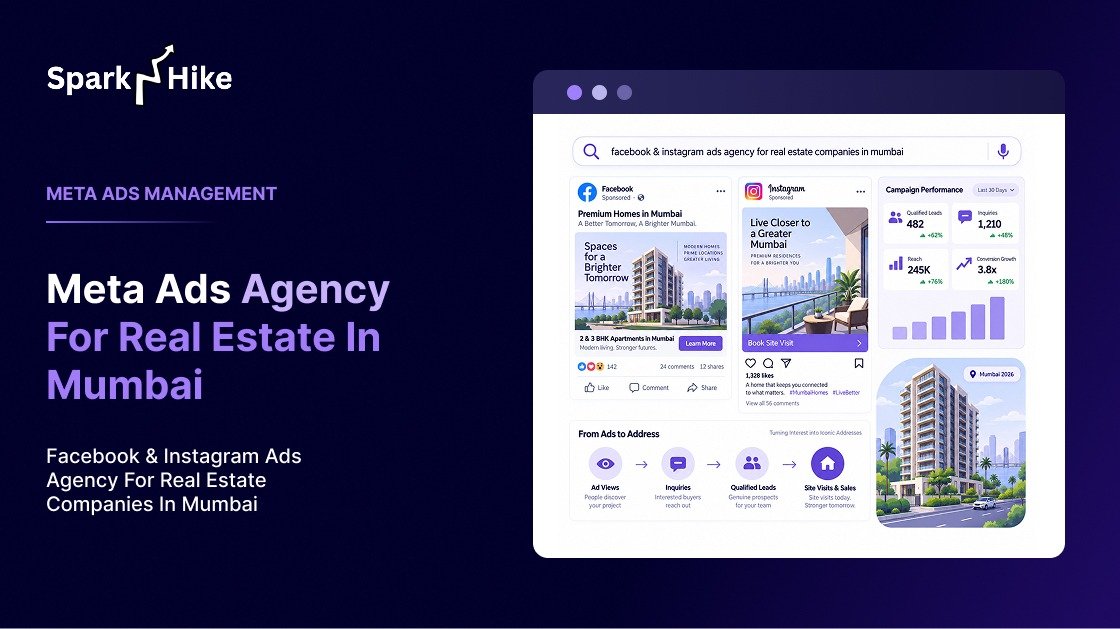
Generating real estate leads in Mumbai is not particularly difficult. Generating qualified property leads who have the budget, location preference and genuine intent to buy is where most campaigns struggle.
A developer can run Facebook and Instagram campaigns, receive hundreds of form submissions and still end the month with very few site visits. The problem is rarely Meta Ads alone. It is usually the way the campaign is structured—from audience strategy and property positioning to creative, lead qualification and sales follow-up.
For developers, real estate companies, brokers and channel partners competing across Mumbai and the wider MMR, Meta Ads can create demand before a buyer starts actively searching for a property. That makes the platform especially useful for new launches, under-construction projects, luxury developments and location-specific residential campaigns.
But success should not be measured by how cheaply a campaign can generate a form submission.
The real objective is to build a system that consistently generates relevant property enquiries and moves more of them towards site visits and bookings.
Why Meta Ads Work for Real Estate Lead Generation in Mumbai
Buying a property is rarely an impulsive decision. Buyers compare locations, developers, configurations, amenities, possession timelines, connectivity and pricing before they are ready to speak with a sales team.
Meta Ads allow real estate brands to enter that decision-making journey earlier.
Instead of depending only on people searching Google for terms such as “2 BHK flats in Mumbai” or “property in Powai,” Facebook and Instagram campaigns can introduce a relevant project while potential buyers are browsing their feeds, Stories or Reels.
This makes Meta Ads for real estate particularly useful for three stages of the property-buying journey.
Creating Awareness
Potential buyers may not know that a new project has launched in their preferred location. Visual campaigns can introduce the property, location, configuration and key benefits before buyers begin actively comparing projects.
Building Consideration
Once buyers are aware of the project, campaigns can communicate details such as amenities, connectivity, floor plans, developer credibility, possession status and pricing.
Generating Enquiries
High-intent campaigns can then encourage interested prospects to request pricing, download a brochure, schedule a call or arrange a site visit.
A good campaign therefore does more than repeatedly show a property advertisement. It moves prospects from discovery towards enquiry.
Turn Your Digital Ideas Into Real Growth.
Let’s build a stronger digital presence that attracts, engages and converts your audience.
Let’s Grow Together GROWTH
The Real Problem Is Not Lead Volume. It Is Lead Quality.
One of the most common mistakes in real estate lead generation in Mumbai is treating cost per lead as the primary measure of success.
Suppose Campaign A generates 200 leads at a lower cost, but only 10 are genuinely interested.
Campaign B generates 100 leads at a higher cost, but 30 of them meet the project’s budget and location criteria and several schedule site visits.
Campaign B is commercially more valuable even though its headline CPL is higher.
Real estate companies should therefore evaluate campaigns beyond the number of form submissions.
A qualified property lead should ideally match several factors:
- Relevant budget range
- Preferred property location
- Suitable configuration
- Reasonable buying timeline
- Genuine contact information
- Interest in the advertised project
- Willingness to speak with the sales team
The job of a professional Meta Ads agency for real estate companies in Mumbai should be to improve this entire lead journey rather than simply reduce form-fill costs.
Start With the Right Property Positioning
Before choosing audiences or launching ads, the campaign needs a clear reason for someone to enquire.
Generic statements such as:
“Luxury 2 & 3 BHK Homes in Mumbai”
are usually not enough on their own.
Mumbai buyers have dozens of developments competing for their attention. The advertisement needs to communicate what makes the project relevant.
Depending on the property, that could include:
Location: Close to a major business district, railway station, metro corridor or important road connection.
Price positioning: Entry price or price range where appropriate.
Configuration: 1 BHK, 2 BHK, 3 BHK, penthouse, commercial office, plotted development or another relevant format.
Project stage: New launch, ready-to-move, nearing possession or under construction.
Amenities: Features that genuinely influence the target buyer rather than a long list of generic amenities.
Developer credibility: Useful when brand reputation can reduce buyer uncertainty.
Investment proposition: Relevant for projects targeting investors rather than primarily end users.
The stronger the project positioning, the easier it becomes to create effective Facebook and Instagram advertising.
Segment Campaigns by Property and Buyer Intent
One campaign should not attempt to communicate with every type of property buyer.
Someone searching for an affordable apartment near Mumbai’s extended suburbs is not evaluating a home using the same criteria as someone considering a premium development in Bandra, Worli or Powai.
Campaign strategy should therefore reflect the individual project.
For example, residential campaigns can be segmented around:
- First-time homebuyers
- Families upgrading to larger homes
- Premium or luxury property buyers
- Property investors
- NRI buyers
- Buyers interested in specific configurations
- Prospects evaluating particular micro-markets
- Existing leads requiring remarketing
Location matters especially in the Mumbai property market.
Campaign messaging for a project in Andheri may focus on completely different advantages from a project in Thane, Panvel, Powai, Goregaon or Navi Mumbai.
Good targeting starts with understanding why someone would consider that particular property, rather than simply selecting a collection of interests inside Ads Manager.
Use Creative That Helps Buyers Evaluate the Property
Real estate is highly visual, which makes Facebook and Instagram valuable platforms when the creative is strong.
However, displaying the same building render repeatedly is unlikely to produce sustainable results.
A complete real estate creative strategy should test different angles.
Project Walkthrough Videos
Short videos can introduce the development, apartment layout, amenities and surroundings more effectively than a static image.
Location-Based Creatives
Show why the location matters.
Instead of simply saying “Prime Location,” communicate meaningful connectivity such as proximity to business districts, transport infrastructure, schools or other relevant landmarks.
Floor Plan Creatives
For prospects already considering the project, configuration and floor-plan information can move them closer to enquiry.
Lifestyle Creatives
These work well when the project’s positioning depends heavily on lifestyle, amenities or premium living.
Price-Led Creatives
Where appropriate, communicating an entry price or pricing range can filter out prospects whose budgets do not match the property.
Construction or Possession Updates
For active developments, progress-based creatives can provide credibility and create urgency among prospects already familiar with the project.
Testimonial and Trust Creatives
Developer track record, completed projects and genuine buyer experiences can help reduce uncertainty.
The objective is not simply to create attractive ads. Each creative should answer a question that buyers are likely to have before making an enquiry.
Facebook Ads and Instagram Ads Need Different Creative Thinking
Although Facebook and Instagram campaigns are managed within the Meta advertising ecosystem, people consume content differently across placements.
Instagram campaigns often benefit from highly visual property presentation, short videos, Reels and lifestyle-led creative.
Facebook can work well with slightly more detailed communication, lead-generation campaigns, remarketing and audiences engaging with property-related content.
Rather than assuming one placement will always outperform another, campaigns should collect performance data and allow budget allocation to follow the opportunities producing better business outcomes.
That is one reason experienced Facebook Ads management for real estate involves continuous creative and placement testing rather than setting up a campaign once and leaving it unchanged.
Instant Forms vs Landing Pages: Which Is Better for Property Leads?
Both can work, but they serve different purposes.
Meta Instant Forms
Instant Forms reduce friction because prospects can submit their information without leaving Facebook or Instagram.
They can work particularly well for:
- Brochure requests
- New launch enquiries
- Price requests
- Callback campaigns
- Large-scale lead generation
However, reducing friction too much can sometimes increase the number of low-intent submissions.
Adding appropriate qualification questions can help improve lead quality.
Dedicated Property Landing Pages
A landing page gives buyers more information before they submit an enquiry.
It can include:
- Property overview
- Project images
- Configurations
- Amenities
- Location advantages
- Developer information
- Pricing information
- Floor plans
- Brochure request
- Site-visit CTA
Because users need to take an additional step before enquiring, landing-page campaigns may sometimes produce fewer leads but potentially stronger intent.
A good real estate marketing agency in Mumbai should test both approaches rather than assuming that one lead-generation method works for every development.
Ask Better Questions to Improve Lead Quality
A form containing only name, email and phone number gives the sales team very little information.
For property campaigns, strategically selected qualification questions can make a significant difference.
Depending on the project, forms may ask:
Which configuration are you interested in?
1 BHK / 2 BHK / 3 BHK / Other
What is your approximate budget?
When are you planning to purchase?
Immediately / 1–3 months / 3–6 months / Exploring
Are you buying for?
Self-use / Investment
Would you like to schedule a site visit?
Forms should not become unnecessarily long. Every additional field creates friction.
The aim is to find the right balance between lead volume and sales qualification.
Turn Your Digital Ideas Into Real Growth.
Let’s build a stronger digital presence that attracts, engages and converts your audience.
Let’s Grow Together
GROWTH
Build Different Campaigns for Different Funnel Stages
Running one lead-generation campaign continuously is rarely the best approach.
A more structured Meta Ads strategy for real estate can separate prospects according to their level of familiarity with the project.
Stage 1: Project Discovery
Introduce the development to relevant audiences using visual content, location benefits, lifestyle positioning and key project highlights.
Stage 2: Consideration
Reach people who have engaged with the project and show more detailed information such as floor plans, amenities, pricing, walkthroughs or connectivity.
Stage 3: Lead Generation
Encourage stronger prospects to request pricing, receive the brochure, contact the sales team or schedule a site visit.
Stage 4: Remarketing
Reconnect with prospects who:
- Visited the property page
- Watched project videos
- Engaged with Instagram or Facebook content
- Opened but did not submit a lead form
- Previously submitted an enquiry
- Interacted with campaign creatives
A prospect who already knows the development should not continue receiving the exact advertisement shown to a completely new audience.
Remarketing creative should move the conversation forward.
Do Not Ignore Meta’s Advertising Requirements for Housing
Real estate advertisers also need to operate within Meta’s applicable advertising rules.
Meta identifies housing or real-estate advertising within its housing-related advertising framework, and certain targeting options can be restricted depending on the applicable market and campaign classification. Campaigns should therefore be structured around current platform requirements rather than attempting to use discriminatory or prohibited targeting methods.
This makes creative quality, first-party data, campaign signals and conversion feedback increasingly important.
Connect Meta Ads With Your Sales Process
A marketing campaign cannot compensate for a weak sales process.
For real estate especially, response time matters.
A prospect who has submitted enquiries for several Mumbai projects may receive calls from multiple developers or brokers within a short period.
Your process should therefore move new leads quickly from Meta into the sales workflow.
An effective system may look like:
Meta Ad → Lead Form/Landing Page → CRM → Immediate Lead Assignment → Call/WhatsApp Follow-Up → Qualification → Site Visit → Sales Follow-Up
Where possible, teams should track what happens after the lead is generated.
Knowing that a campaign generated 150 leads is useful.
Knowing that it produced:
- 150 enquiries
- 70 connected calls
- 30 qualified prospects
- 16 scheduled site visits
- 10 completed site visits
- 2 bookings
is far more useful.
That information allows advertising decisions to be based on revenue potential rather than surface-level advertising metrics.
Metrics Real Estate Companies Should Actually Monitor
CPL still matters, but it should be viewed alongside deeper sales metrics.
| Metric | What It Tells You |
| Cost Per Lead | Cost of generating each enquiry |
| Qualified Lead Rate | Percentage of leads meeting key criteria |
| Contact Rate | Percentage successfully reached by sales |
| Cost Per Qualified Lead | Actual cost of generating relevant prospects |
| Site Visit Rate | Percentage progressing to property visits |
| Cost Per Site Visit | Advertising efficiency further down the funnel |
| Booking Rate | Number of prospects converting into buyers |
| Cost Per Acquisition | Actual cost of generating a completed sale |
If the CPL increases slightly while the cost per qualified lead or cost per site visit improves, the campaign may actually be performing better.
Why Cheap Real Estate Leads Often Become Expensive
There is a significant difference between cheap leads and efficient lead generation.
Campaigns designed only to minimize CPL can attract:
- People outside the required budget range
- Users interested in a different location
- Accidental form submissions
- Prospects with no immediate purchase intent
- Invalid contact details
- People looking for completely different properties
Sales teams then spend hours calling leads that were unlikely to convert in the first place.
A stronger campaign may intentionally create slightly more friction through clearer pricing, qualification questions and detailed project communication.
This can reduce total lead volume while improving the percentage of leads worth pursuing.
Meta Ads and Google Ads Should Work Together
Meta Ads and Google Ads play different roles in real estate marketing.
Meta is particularly strong at generating discovery and demand through Facebook and Instagram.
Google Search captures people who are actively searching for a property, location or developer.
For example, someone may first discover a property through an Instagram Reel and later search Google for:
“Project name Mumbai”
“2 BHK in Powai”
“New property projects in Andheri”
or another related query.
Running both channels can therefore create a more complete paid acquisition strategy.
Meta builds and recaptures demand, while Google can capture stronger existing search intent.
Real estate companies with sufficient campaign budgets should evaluate performance across the complete customer journey instead of treating each advertising platform as an isolated channel.
Common Meta Ads Mistakes Real Estate Companies Should Avoid
Even a strong property can underperform when the campaign execution is weak.
Some of the most common problems include:
Running the Same Creative for Months
Creative fatigue can gradually reduce response. New hooks, formats, project angles and visual concepts should be tested regularly.
Focusing Only on CPL
Optimizing exclusively for cheaper submissions can negatively affect sales quality.
Generic Location Messaging
Mumbai buyers frequently make decisions at a micro-market level. Campaign communication should reflect the project’s actual location advantage.
Weak Landing Pages
Sending paid traffic to a slow or generic corporate website can reduce conversions.
No Lead Qualification
Every enquiry should not automatically be treated as an equally valuable prospect.
Slow Sales Follow-Up
Advertising can generate the opportunity, but the sales team still needs to act while buyer interest is fresh.
No Remarketing Strategy
Many property buyers need repeated exposure before they are comfortable making an enquiry or arranging a visit.
Poor Conversion Tracking
Without reliable tracking, advertisers may shift budget based on incomplete information.
How SparknHike Approaches Meta Ads for Real Estate Companies in Mumbai
Real estate performance marketing requires more than launching Lead Ads and monitoring cost per form submission.
SparknHike approaches Meta Ads for real estate companies in Mumbai around the complete journey from audience discovery to qualified enquiry.
Our Meta Ads management combines campaign strategy, audience planning, creative testing, lead-generation campaigns, conversion tracking and ongoing optimization. Instead of treating reach or impressions as the final objective, campaigns are structured around actions that matter commercially.
For real estate businesses, those actions can include:
- Qualified property enquiries
- Brochure requests
- Calls
- WhatsApp conversations
- Site-visit enquiries
- Project registrations
- Other measurable conversion actions
The approach is particularly relevant for developers, real estate companies and property businesses that want their advertising decisions to be based on meaningful lead and conversion data.
Meta Ads Management for Real Estate
SparknHike builds Facebook and Instagram campaigns around the individual project rather than applying the same campaign structure to every property.
This can include:
Campaign Strategy
We define the campaign objective, property positioning, buyer journey, conversion actions and testing approach before scaling advertising activity.
Audience Strategy
Campaign audiences are planned around relevant signals, available first-party data, location requirements and Meta’s applicable advertising policies.
Creative Strategy
We develop and test different messaging angles around the property’s strongest selling points instead of depending on one repetitive creative.
Lead Generation
Campaigns can use Meta lead forms or conversion-focused landing pages depending on the property, buyer journey and campaign objective.
Remarketing
Interested prospects can be re-engaged with more relevant messages based on previous interactions with the project.
Conversion Tracking
Important actions are measured so optimization decisions can move beyond impressions, clicks and superficial engagement.
Performance Optimization
Audiences, creatives, budgets and campaign structures are continuously reviewed based on performance data.
SparknHike’s broader Meta Ads management service is designed around audience strategy, creative testing and conversion measurement rather than simply boosting posts or maximizing reach.
Combine Meta Ads With Google Ads for Higher-Intent Property Searches
SparknHike can also connect Meta campaigns with Google Ads management for developers that want to capture buyers already searching for relevant properties.
Google Search campaigns can target commercially relevant searches around property type, location, project or buying intent, while Meta supports discovery, consideration and remarketing.
SparknHike’s Google Ads service focuses on keyword intent, campaign structure, negative keywords, budget management and conversion tracking to reduce wasted traffic and generate more valuable enquiries.
This creates a more balanced acquisition strategy:
Meta Ads: Create and nurture demand.
Google Ads: Capture active search demand.
Remarketing: Reconnect with prospects who have already shown interest.
Landing Pages: Convert advertising traffic into enquiries.
Tracking: Identify which campaigns are producing meaningful business results.
Landing Page and Website Support for Real Estate Campaigns
Advertising performance also depends on what happens after someone clicks.
If a property landing page is slow, confusing or missing important information, increasing advertising spend will not solve the underlying conversion problem.
A conversion-focused real estate landing page should make it easy for prospective buyers to understand:
- What the project offers
- Where it is located
- Which configurations are available
- Why the development is worth considering
- What action they should take next
SparknHike can support the wider conversion journey through web development and landing-page optimization alongside paid advertising, helping reduce the disconnect between the advertisement and the enquiry experience.
Why Choose SparknHike as Your Meta Ads Agency for Real Estate in Mumbai?
SparknHike focuses on building paid campaigns around business outcomes rather than presenting large impression numbers as campaign success.
For real estate campaigns, that means looking deeper than the number of leads generated.
We focus on the elements that influence whether advertising creates genuine opportunities:
Project-specific strategy
Campaigns are built around the property, audience and commercial objective.
Creative testing
Multiple messages and visual approaches can be tested to identify stronger opportunities.
Lead-quality focus
Campaign performance is evaluated using meaningful conversion signals rather than CPL alone.
Conversion tracking
Tracking helps determine where enquiries originate and which campaigns deserve additional investment.
Continuous optimization
Campaign decisions are adjusted as audience, creative and conversion data develops.
The objective is straightforward: help real estate businesses use Facebook and Instagram advertising to generate more relevant enquiries and make better use of their advertising budgets.
How Much Should Real Estate Companies Spend on Meta Ads?
There is no single Meta Ads budget that is right for every property project.
Budget requirements depend on factors such as:
- Property price
- Target location
- Audience size
- Project stage
- Competition
- Campaign objective
- Available creative
- Sales targets
- Expected lead volume
- Historical advertising data
A luxury development targeting a narrow buyer segment should not necessarily use the same budget strategy as a high-volume residential project.
Rather than selecting an arbitrary daily amount, the campaign should have enough budget to generate meaningful data, test different creatives and audiences, and identify which combinations are producing stronger results.
Budgets can then be increased progressively around campaigns demonstrating better lead quality and downstream performance.
Should You Hire a Real Estate Meta Ads Agency in Mumbai?
Managing a small campaign internally can work when the business already has experienced advertising resources.
Hiring a specialized agency becomes more valuable when you need support across:
- Campaign strategy
- Facebook and Instagram Ads
- Creative planning
- Multiple property projects
- Lead-generation funnels
- Landing pages
- Conversion tracking
- Remarketing
- Budget optimization
- Performance reporting
The key is not simply finding an agency that can operate Meta Ads Manager.
Choose a partner that understands how advertising connects with property positioning, lead qualification, sales follow-up and revenue.
Generate More Qualified Property Leads With SparknHike
Real estate companies do not need another dashboard filled with impressions, reach and inexpensive leads that never answer the phone.
They need advertising that creates genuine sales opportunities.
SparknHike provides Meta Ads management for real estate companies in Mumbai, combining Facebook and Instagram advertising with audience strategy, creative testing, lead-generation funnels, conversion tracking and ongoing campaign optimization.
Whether you are promoting a new residential development, premium property, commercial project or multiple real estate projects, we can build a campaign strategy around the audiences and conversions that matter to your business.
Looking to generate more qualified property enquiries from Facebook and Instagram?
Talk to SparknHike about a Meta Ads strategy built around your project, market, and growth goals.
Turn Your Digital Ideas Into Real Growth.
Let’s build a stronger digital presence that attracts, engages and converts your audience.
Let’s Grow Together
GROWTH