
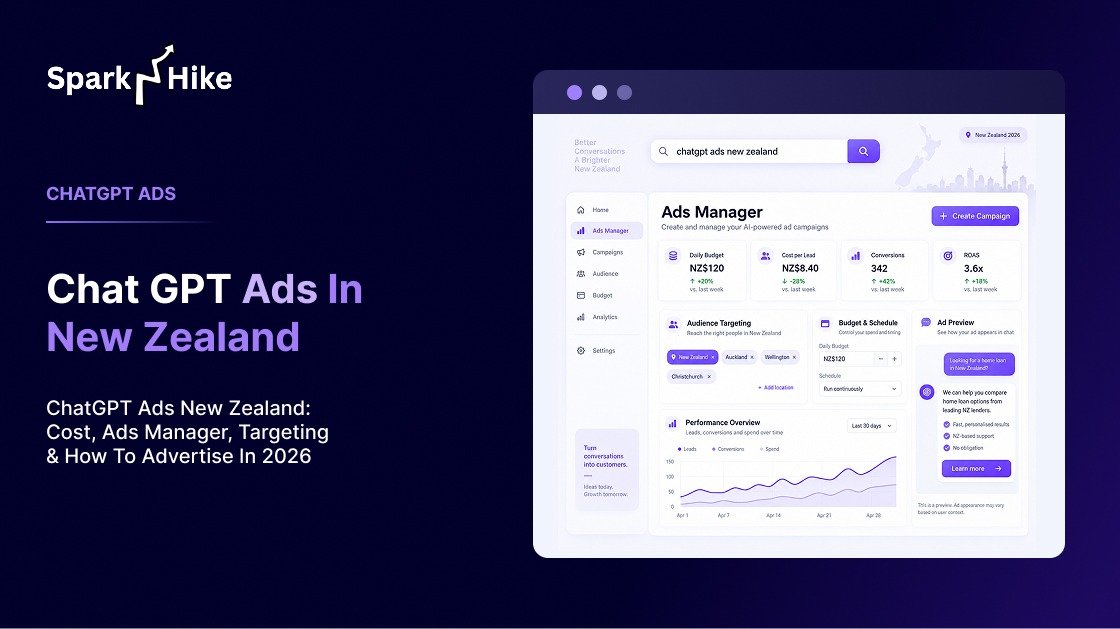
Digital advertising is entering another major shift.
For years, New Zealand businesses looking for paid traffic have largely relied on Google Ads, Facebook Ads, Instagram Ads, LinkedIn and other established advertising platforms. In 2026, another channel has entered that conversation: ChatGPT Ads.
OpenAI is expanding advertising inside ChatGPT, giving businesses an opportunity to reach people while they are researching products, comparing providers, evaluating options and making decisions through conversational AI.
For businesses in Auckland, Christchurch, Wellington, Hamilton, Tauranga and other parts of New Zealand, this creates a new advertising opportunity that works differently from traditional paid search or social media.
ChatGPT Ads Manager is now available for eligible self-service advertisers in New Zealand, making it possible for businesses to create and manage campaigns directly through OpenAI’s advertising platform.
But how do ChatGPT Ads work? What does it cost to advertise on ChatGPT in New Zealand? How does targeting work? And should businesses shift budget away from Google Ads or Meta Ads?
This guide explains what New Zealand advertisers need to know about ChatGPT advertising in 2026, including costs, Ads Manager, targeting, campaign setup, conversion tracking and where ChatGPT Ads may fit into a broader digital marketing strategy.
What Are ChatGPT Ads?
ChatGPT Ads are paid advertisements displayed within the ChatGPT experience.
Instead of relying only on a short search query, ChatGPT can understand the broader context of a conversation. This means advertisements can potentially appear when a user is actively researching, comparing products, exploring services or trying to make a decision.
According to OpenAI, ads are displayed separately from ChatGPT’s answers and are clearly identified as advertisements. A standard ad can include the advertiser’s name, favicon or logo, headline, description, landing page and image creative.
For example, someone may ask ChatGPT:
“What accounting software is suitable for a growing New Zealand construction company?”
That conversation contains much more commercial context than a traditional two- or three-word search query.
A relevant accounting software provider could potentially become eligible for an advertisement around that conversation if its campaign, landing page, ad copy and contextual information match what the user is trying to accomplish.
That difference is important.
Google Search advertising is strongly influenced by the words somebody searches. ChatGPT advertising can evaluate the broader intent and context behind a conversation.
Are ChatGPT Ads Available in New Zealand?
Yes.
As of September 2026, New Zealand is listed by OpenAI as a market where self-service Ads Manager access is available. Eligible New Zealand businesses can therefore create an advertiser account and manage campaigns through OpenAI Ads Manager Beta.
New Zealand was also included in OpenAI’s international expansion of its ChatGPT advertising pilot after the initial US test.
That makes 2026 particularly interesting for New Zealand advertisers.
Established channels such as Google Ads and Meta Ads already have mature advertiser ecosystems and intense competition. ChatGPT Ads are comparatively new, meaning businesses are still learning how campaign structure, conversational intent, context hints and creative strategy influence performance.
Early adoption does not guarantee cheaper leads or better returns, but it gives marketers time to learn the platform before it becomes another standard paid-media channel.
How Do Ads Appear in ChatGPT?
ChatGPT Ads are designed to remain separate from organic ChatGPT answers.
OpenAI currently places ads below responses when its advertising system determines there is an eligible and relevant match. Advertisements are visibly identified so users can distinguish sponsored content from ChatGPT’s normal answer.
This distinction matters because an advertiser does not pay to change what ChatGPT recommends in its normal answer.
Advertising and organic AI visibility are therefore two different strategies.
A business may run ChatGPT Ads to obtain paid exposure while simultaneously working on AEO and GEO strategies to improve how its brand, website and expertise are represented organically across AI-assisted discovery.
Businesses entering AI search marketing should consider both rather than treating paid advertising as a replacement for organic visibility.
Turn Your Digital Ideas Into Real Growth.
Let’s build a stronger digital presence that attracts, engages and converts your audience.
Let’s Grow Together GROWTH
Why ChatGPT Advertising Could Matter for New Zealand Businesses
The biggest difference between ChatGPT and many traditional advertising environments is the amount of information users provide when they are researching something.
A conventional Google search may look like:
CRM software NZ
A ChatGPT conversation may instead contain:
“We run a 15-person sales team in Auckland and need a CRM that integrates with Xero, handles automated follow-ups and costs less than NZ$100 per user. What options should we compare?”
The second interaction provides substantially more context.
ChatGPT’s advertising system considers factors including the current conversational context and intent, the advertiser’s landing page, ad title, ad copy and advertiser-provided context hints. Where ad personalization is enabled, additional eligible signals may also contribute to determining relevance.
This creates opportunities for businesses offering products or services where customers usually conduct research before purchasing.
That may include eCommerce, SaaS, professional services, education, travel, property-related services, home services, financial software, B2B services and other considered purchases.
What Is OpenAI Ads Manager?
OpenAI Ads Manager Beta is the self-service platform used to create, launch, manage and analyse ChatGPT advertising campaigns.
Advertisers can use the platform to build campaigns, organise advertising into ad groups, create individual ads, manage billing and monitor performance. OpenAI also supports bulk campaign creation for supported campaign types.
A typical ChatGPT advertising structure follows three levels:
Campaign → Ad Group → Ad
The campaign controls broader settings such as the advertising objective, budget, dates and targeting.
The ad group organises ads around a particular product, service, customer requirement or intent and is where advertisers can add context hints.
The individual ad contains the message people may actually see, including the title, description, landing page and visual creative.
This structure will feel familiar to businesses already using Google Ads or Meta Ads, although ChatGPT’s relevance system introduces a different approach to audience intent.
ChatGPT Ads Cost in New Zealand
One of the most common questions New Zealand businesses are beginning to ask is:
How much do ChatGPT Ads cost?
There is no universal fixed price for every ChatGPT advertisement.
Actual costs depend on factors such as the campaign objective, bid, competition, relevance, audience opportunity and campaign delivery.
However, OpenAI currently states that the minimum daily campaign budget for accounts billed in New Zealand dollars is NZ$25 per day.
That means the platform is accessible to businesses that want to begin testing without immediately committing enterprise-level advertising budgets.
| ChatGPT Ads Cost Factor | Current Information |
| Minimum daily budget in NZD | NZ$25 |
| Views campaigns | Impression-based buying |
| Clicks campaigns | Valid-click/CPC-based buying |
| Conversion campaigns | Optimised towards supported conversion events |
| CPC bidding | Maximum CPC set at ad-group level |
| CPM bidding | Maximum CPM used for reach campaigns |
| Auction | Relevance-weighted second-price auction |
For CPC campaigns, OpenAI currently recommends advertisers consider starting with a maximum CPC bid of US$3–US$5, although the actual amount paid can vary because ad selection uses an auction system rather than a fixed rate card.
New Zealand advertisers should therefore avoid assuming that NZ$25 per day represents the amount required to generate meaningful leads.
The minimum simply determines whether a campaign can run.
A suitable working budget should instead depend on the expected customer value, campaign objective, available advertising opportunities, conversion rate and how much testing is required before making performance decisions.
ChatGPT Ads Campaign Objectives
ChatGPT Ads Manager currently supports advertising objectives built around Views, Clicks and Conversions.
A Views campaign is more suitable when the priority is reach or brand exposure.
Clicks campaigns are designed to drive users towards a website or landing page and use valid-click billing.
Conversion-focused campaigns attempt to optimise delivery towards a supported conversion event such as a purchase, lead submission or sign-up. OpenAI supports conversion optimisation using click-based and, for eligible campaign configurations, impression-based approaches.
Choosing the correct objective should depend on the actual business outcome rather than simply selecting whichever campaign type appears cheapest.
For an Auckland SaaS company seeking free-trial registrations, conversion optimisation may eventually become more valuable than maximising raw clicks.
A New Zealand brand launching an unfamiliar product, on the other hand, may initially want wider visibility before expecting direct conversions.
How Does ChatGPT Ads Targeting Work?
This is where ChatGPT advertising becomes noticeably different from traditional search advertising.
Although advertisers can provide phrases associated with topics and customer needs, ChatGPT does not simply treat these as exact-match advertising keywords.
Instead, advertisers provide context hints.
Context hints give OpenAI additional information about what the advertiser offers, who the product or service may help and situations where it may be useful.
OpenAI explicitly states that context hints influence relevance but are not exact targeting instructions and do not guarantee that an advertisement will appear for a particular conversation.
For example, a New Zealand web development company would gain little from submitting an extremely broad hint such as:
“website development”
A more useful contextual phrase could describe:
“custom WordPress and eCommerce website development for New Zealand businesses planning to redesign an outdated website or launch online sales.”
The second version communicates the service, customer and situation.
That gives the system richer information for determining relevance.
This is why ChatGPT advertising strategy should focus less on keyword stuffing and more on understanding the real situations that lead potential customers to need a product or service.
Location Targeting for New Zealand Campaigns
Location remains important even in conversational advertising.
Advertisers can choose countries where campaigns are eligible to appear. OpenAI also supports additional location options such as regions, cities, markets or postal codes where those options are available for the particular campaign and country.
That means a business does not necessarily need to treat the whole New Zealand market identically.
A service provider may build different strategies for Auckland, Christchurch or Wellington when the economics, offering or landing page genuinely differ by market.
Businesses should nevertheless avoid creating unnecessary location fragmentation.
If the same service, pricing and landing page apply nationwide, one well-structured New Zealand campaign may produce cleaner data than splitting a small budget across many cities.
Where a business genuinely serves particular areas, locations such as Auckland, Christchurch, Wellington, Hamilton and Tauranga can become part of its ChatGPT Ads strategy as the platform’s supported targeting options allow.
Platform Targeting
ChatGPT Ads Manager also allows advertisers to select supported delivery platforms.
Current options can include Android app, Android web, desktop web, iOS app and iOS web, with availability varying by location.
Initially, many advertisers may benefit from keeping broader platform coverage and analysing performance before making aggressive exclusions.
A campaign should be narrowed because the data supports the decision, not simply because one device category seems less attractive.
Custom Audiences
ChatGPT Ads also supports custom audiences.
Advertisers can create audiences using eligible customer or prospect information and then use those audiences for campaign inclusion or exclusion.
For example, a business could exclude existing customers from a new-customer acquisition campaign or create an eligible audience around qualified prospects already present in its CRM.
This moves ChatGPT advertising beyond purely contextual discovery and gives performance marketers additional ways to combine first-party business data with conversational advertising opportunities.
Any customer information used for advertising should, of course, be handled according to applicable privacy requirements and OpenAI’s policies.
How to Advertise on ChatGPT in New Zealand
For businesses researching how to advertise on ChatGPT, the practical process can be summarised as follows:
- Create an OpenAI Ads Manager account. Use a work-related OpenAI account, establish the advertiser profile, add branding information, complete billing and finish the required account verification process.
- Choose the campaign objective. Decide whether the campaign should prioritise views, website clicks or conversions.
- Set the campaign budget and dates. New Zealand dollar campaigns currently require at least NZ$25 per day. Avoid judging performance from only a few impressions or clicks.
- Define geographic and platform targeting. Select New Zealand and any supported location or platform requirements that genuinely match the business.
- Create focused ad groups. Separate different services, products or customer requirements instead of putting unrelated offers into one ad group.
- Write useful context hints. Describe what the product does, who it helps and situations where it becomes relevant. Do not treat context hints as a list of exact-match SEO keywords.
- Create several ad variations. Use clear headlines, concise descriptions, strong landing pages and useful visual assets rather than relying on one generic advertisement.
- Install conversion measurement. Configure the appropriate conversion events so the campaign can be evaluated against genuine business actions rather than clicks alone.
- Launch and monitor performance. Review delivery, CTR, CPC, CPM, conversions and conversion quality, then adjust the campaign based on sufficient data.
- Scale what produces business outcomes. Move budget towards ad groups, contextual themes, landing pages and creatives that lead to qualified conversions rather than simply generating cheap traffic.
What Does a ChatGPT Advertisement Include?
A ChatGPT advertisement can contain the advertiser’s brand name, favicon, headline, description, landing page and an image asset.
OpenAI’s campaign documentation currently recommends concise creative.
Its guidance suggests ad titles of roughly 16–24 characters where practical, with a maximum of 50 characters, while ad descriptions are recommended around 32–48 characters with a maximum of 100 characters. Square PNG or JPG images can be used within the supported creative requirements.
The character limits make clarity especially important.
A vague headline such as:
“Transform Your Future Today”
does not explain enough.
An advertisement should communicate what is being offered and why it is relevant.
That could mean focusing on price, functionality, use case, availability, speed, convenience or another genuine customer benefit.
ChatGPT Ads vs Google Ads vs Meta Ads
ChatGPT Ads should not automatically be treated as a replacement for Google or Meta advertising.
Each platform captures customers differently.
| Platform | Strongest Intent Signal | Typical Strength |
| ChatGPT Ads | Conversational context and decision-making intent | Reaching users while they research and compare |
| Google Search Ads | Explicit search query | Capturing existing search demand |
| Meta Ads | Audience behaviour and interests | Creating demand and reaching broad audiences |
A Google user searching “emergency plumber Auckland” already knows exactly what service is required.
A ChatGPT user may instead explain a situation, ask what is causing a plumbing problem, compare repair options and then ask which type of service should be contacted.
Those are different moments in the customer journey.
For many businesses, the strongest strategy may eventually involve all three channels.
Google Ads captures explicit search demand.
Meta Ads can build awareness and stimulate demand.
ChatGPT Ads can help the brand appear while customers are researching, evaluating and narrowing down their options.
Turn Your Digital Ideas Into Real Growth.
Let’s build a stronger digital presence that attracts, engages and converts your audience.
Let’s Grow Together
GROWTH
ChatGPT Ads Conversion Tracking
Advertising performance becomes difficult to optimise when the only metric available is website traffic.
ChatGPT Ads supports conversion measurement so businesses can track actions such as lead submissions, purchases or registrations.
Advertisers can currently send conversion events using the OpenAI Pixel, Conversions API or both. OpenAI uses those events to connect eligible user actions with advertising interactions and campaign optimisation.
Using both browser-side and server-side measurement can create a more resilient tracking setup where implemented correctly.
Businesses can also add UTM parameters to ChatGPT Ads landing-page URLs, allowing traffic to be identified within existing analytics systems.
For lead-generation businesses, this is particularly important.
A campaign producing 50 inexpensive leads is not necessarily better than a campaign generating 20 leads if the smaller campaign produces more qualified sales opportunities.
The real measurement strategy should therefore connect advertising performance to downstream outcomes wherever possible.
Metrics Available in ChatGPT Ads Manager
OpenAI Ads Manager currently provides reporting for important paid-media metrics including impressions, clicks, spend, click-through rate, average CPC, average CPM and attributed conversions when conversion tracking has been configured.
Advertisers should interpret these metrics together.
A high CTR may indicate that an ad matches user interest, but it tells you little about whether the landing page converts.
A low CPC can look attractive but become expensive if those clicks rarely generate customers.
A higher CPC may still deliver better return when the associated users are more qualified.
For this reason, ChatGPT Ads management should be based on cost per meaningful business outcome, not simply cost per click.
Landing Pages Will Matter as Much as Ad Targeting
One mistake New Zealand businesses should avoid is putting all their attention into ChatGPT Ads targeting while sending every visitor to a generic homepage.
The landing page contributes to both relevance and conversion performance.
A person clicking a ChatGPT advertisement after discussing a very specific problem expects the destination page to continue that conversation.
If the advertisement discusses Shopify development for New Zealand retailers, users should ideally land on a page explaining Shopify development rather than a broad agency homepage containing ten unrelated services.
Strong ChatGPT advertising campaigns should align the conversation context, context hint, advertisement, landing page and conversion goal.
This is also where SEO, PPC, website development and conversion optimisation begin to overlap.
Creating Better Context Hints
Context hints are likely to become one of the most important skills for advertisers learning the platform.
Rather than asking only:
“Which keywords should we target?”
marketers need to ask:
“What circumstances cause someone to need our service?”
A mortgage-related business may want to understand the situations that occur before somebody actively seeks a provider.
A SaaS company should understand the operational problems that cause teams to compare software.
An eCommerce brand should understand product requirements, preferences, occasions and decision criteria.
This approach requires more customer understanding than copying a list of Google Ads keywords into a new advertising platform.
For SparknHike’s ChatGPT advertising campaigns, this means analysing the business, customer intent and buying journey before building ad groups and contextual themes.
Creative Strategy for ChatGPT Advertising
OpenAI recommends creating multiple distinct ad variations rather than repeatedly presenting the same message.
Different ads within the same ad group can communicate different benefits or use cases, giving the advertising system more ways to find relevant opportunities.
For example, a New Zealand accounting platform could test one ad around saving administrative time, another around Xero integration and another around multi-location reporting.
All three promote the same product but respond to different customer needs.
That is more useful than creating five advertisements where only one word changes.
Privacy and ChatGPT Advertising
Privacy is understandably one of the biggest questions surrounding advertising inside conversational AI.
OpenAI states that advertisers do not receive users’ ChatGPT conversations, chat histories, memories or personal details, and that user data is not sold to advertisers. Advertisers receive aggregated advertising performance information rather than access to individual conversations.
OpenAI also states that advertisements remain separate from ChatGPT’s answers and do not influence the answers generated by ChatGPT.
That distinction should be understood by both advertisers and consumers.
Running ChatGPT Ads does not mean paying OpenAI to make ChatGPT organically recommend a particular company.
Paid advertising visibility and organic AI recommendations operate separately.
Who Can See ChatGPT Ads?
ChatGPT advertising is not displayed to every ChatGPT user.
OpenAI currently states that ads may appear to eligible users on its Free and Go plans, while Plus, Pro and business-oriented paid plans do not show these advertisements. Accounts identified as belonging to users under 18 are also excluded.
Advertisers should factor that available audience into campaign expectations.
The potential advertising market is substantial, but it is not equivalent to targeting every ChatGPT user.
What Types of New Zealand Businesses Should Test ChatGPT Ads?
ChatGPT advertising may be particularly interesting when customers need to research before buying.
For example, software buyers often compare features, pricing and integrations.
Homeowners research problems and potential solutions before hiring tradespeople.
Travellers compare destinations, accommodation and activities.
Businesses research agencies, software vendors and professional service providers before requesting proposals.
Consumers compare larger purchases before deciding where to buy.
These are the kinds of situations where conversational context becomes commercially meaningful.
However, businesses should not launch ChatGPT Ads simply because the platform is new.
If the website cannot convert visitors, the offer is weak or the company cannot measure leads properly, adding another traffic source will not solve the underlying problem.
ChatGPT Ads Agency New Zealand: How SparknHike Can Help
Running ChatGPT Ads involves more than opening Ads Manager and setting a daily budget.
Businesses need to understand conversational intent, organise offers into relevant ad groups, develop meaningful context hints, create advertisements, optimise landing pages and establish accurate conversion measurement.
SparknHike provides ChatGPT advertising services for businesses targeting customers across New Zealand.
Our approach connects ChatGPT Ads with the wider paid-media and digital marketing strategy rather than treating it as an isolated experiment.
We can help businesses with campaign planning, OpenAI Ads Manager setup, contextual targeting strategy, ad-group structure, context hints, creative messaging, landing-page recommendations, conversion tracking and ongoing campaign optimisation.
For brands already investing in Google Ads, Meta Ads, PPC services, SEO or digital marketing, ChatGPT advertising can be tested alongside existing campaigns so performance can be evaluated against the channels already generating traffic and enquiries.
ChatGPT Ads Services for Auckland Businesses
Auckland represents New Zealand’s largest commercial market and is therefore an obvious testing ground for businesses exploring new advertising channels.
A business targeting Auckland customers can build a campaign around genuinely local services, availability and customer requirements rather than simply adding the word “Auckland” to generic advertisements.
For example, a service-based company can align its context hints, advertising message and landing page around customers specifically looking for providers serving Auckland.
SparknHike can help Auckland businesses develop ChatGPT Ads campaigns while also coordinating the strategy with Google Ads, Meta Ads, SEO, website optimisation and conversion tracking.
The objective should not be to be present on every advertising platform.
It should be to determine which combination generates qualified customers at a commercially sustainable cost.
Why Work With SparknHike for ChatGPT Advertising?
ChatGPT Ads require a different mindset from traditional keyword advertising.
SparknHike combines paid advertising strategy with search intent, landing-page optimisation, SEO, AEO, GEO and conversion-focused digital marketing.
That allows us to look beyond surface-level metrics.
Instead of measuring success only through impressions or clicks, the strategy can focus on whether campaigns are producing relevant traffic, enquiries, registrations, purchases or other meaningful business actions.
For businesses testing ChatGPT advertising in New Zealand, this integrated approach can help ensure that Ads Manager setup, messaging, targeting and the website experience work together.
Common ChatGPT Ads Mistakes to Avoid
One of the easiest mistakes is approaching ChatGPT Ads exactly like Google Search Ads.
Context hints are not conventional exact-match keywords.
Another problem is using overly broad ad groups. A campaign promoting several unrelated services gives the advertising system less clarity around what each advertisement is meant to solve.
Weak landing pages can also waste advertising spend.
If somebody arrives with highly specific intent and lands on an unfocused page, much of the benefit of conversational targeting is lost.
Advertisers should also avoid making decisions from very small datasets.
A new campaign may need time to generate enough impressions, clicks and conversions before performance differences become meaningful.
Finally, businesses should remember that the platform remains in beta. OpenAI continues to develop campaign functionality, delivery, reporting and advertising formats, so strategies that work today may need to evolve as the advertising ecosystem matures.
Are ChatGPT Ads Better Than Google Ads?
Not automatically.
Google Ads and ChatGPT Ads capture different behaviour.
Google remains extremely powerful when a customer explicitly searches for a product or service.
ChatGPT may be particularly valuable earlier in the decision process, when customers are explaining a problem, researching alternatives and comparing options.
A local business should therefore avoid moving its entire Google Ads budget simply because ChatGPT Ads are new.
A more sensible approach is controlled testing.
Establish a budget, define the conversion goal, launch a well-structured campaign, measure performance and compare the quality and cost of customers against existing paid channels.
Will ChatGPT Ads Become Important in New Zealand?
The platform is still developing, so no one can responsibly guarantee how large ChatGPT advertising will become.
However, OpenAI has already moved beyond the earliest US advertising test, expanded internationally, introduced self-service Ads Manager, added CPC buying, conversion optimisation, custom audiences and measurement capabilities, and made self-service advertising available in New Zealand.
Those developments suggest that advertisers should at least understand the channel.
Businesses that begin testing early can learn how conversational advertising behaves before competition and campaign complexity increase further.
Final Thoughts
ChatGPT Ads in New Zealand are no longer just an advertising concept businesses need to watch for the future. Self-service Ads Manager access is already available, and New Zealand companies can begin exploring conversational advertising in 2026.
The opportunity is different from traditional paid search.
Rather than focusing entirely on individual keywords, ChatGPT advertising places greater emphasis on context, customer intent, relevance and the decision-making situation surrounding a conversation.
That makes campaign strategy especially important.
Businesses need the right objective, sensible budget, focused ad groups, useful context hints, relevant creative, conversion-focused landing pages and reliable measurement.
For most companies, ChatGPT Ads should initially complement rather than replace established channels such as Google Ads and Meta Ads.
SparknHike helps New Zealand businesses plan and manage ChatGPT Ads as part of a wider performance marketing strategy. Whether you are targeting customers throughout New Zealand or focusing on markets such as Auckland, Christchurch, Wellington, Hamilton or Tauranga, the goal is to turn emerging AI advertising opportunities into measurable business growth rather than simply chasing a new marketing trend.
Frequently Asked Questions About ChatGPT Ads New Zealand
Are ChatGPT Ads available in New Zealand in 2026?
Yes. OpenAI currently lists New Zealand as a country where self-service ChatGPT Ads Manager access is available for eligible advertisers.
How much do ChatGPT Ads cost in New Zealand?
OpenAI currently requires a minimum daily campaign budget of NZ$25 for campaigns billed in New Zealand dollars. Actual CPC or CPM will vary based on factors such as bidding, competition, relevance and campaign delivery.
How can I advertise on ChatGPT in New Zealand?
Businesses can create an account through OpenAI Ads Manager, complete advertiser and billing setup, create a campaign, choose an objective, configure targeting, build ad groups and context hints, create advertisements and launch the campaign once the required checks are complete.
Does ChatGPT Ads Manager use keywords?
Not in exactly the same way as Google Search Ads. Advertisers can provide context hints describing relevant topics, customer needs and situations, but OpenAI states that these are not exact-match keywords and do not guarantee placement in a specific conversation.
Can ChatGPT Ads target Auckland?
OpenAI Ads Manager supports country targeting and can support additional locations such as regions, cities, markets and postal codes where available. Advertisers should confirm currently supported Auckland targeting options inside Ads Manager when creating the campaign.
Can I track leads and sales from ChatGPT Ads?
Yes. OpenAI provides conversion measurement using tools including the OpenAI Pixel and Conversions API. Advertisers can configure supported conversion events and can also use UTM parameters for additional analytics tracking.
Are ChatGPT Ads the same as getting recommended by ChatGPT?
No. Advertisements remain separate from ChatGPT’s normal responses. OpenAI states that advertisers cannot pay to influence ChatGPT’s organic answers. Improving organic visibility in AI answers requires a separate AEO, GEO, SEO and brand-authority strategy.
Which New Zealand businesses should consider ChatGPT advertising?
Businesses where customers research, compare and evaluate options before purchasing may be good candidates. This can include eCommerce, SaaS, B2B services, professional services, travel, property-related businesses and many other industries. The best decision should still be based on customer behaviour, margins, website conversion capability and measurable campaign performance.
Does SparknHike provide ChatGPT Ads services in New Zealand?
Yes. SparknHike provides ChatGPT advertising services for businesses targeting New Zealand customers, including campaign strategy, Ads Manager setup, contextual targeting, ad creation, landing-page recommendations, conversion tracking and ongoing optimisation.
Turn Your Digital Ideas Into Real Growth.
Let’s build a stronger digital presence that attracts, engages and converts your audience.
Let’s Grow Together
GROWTH