
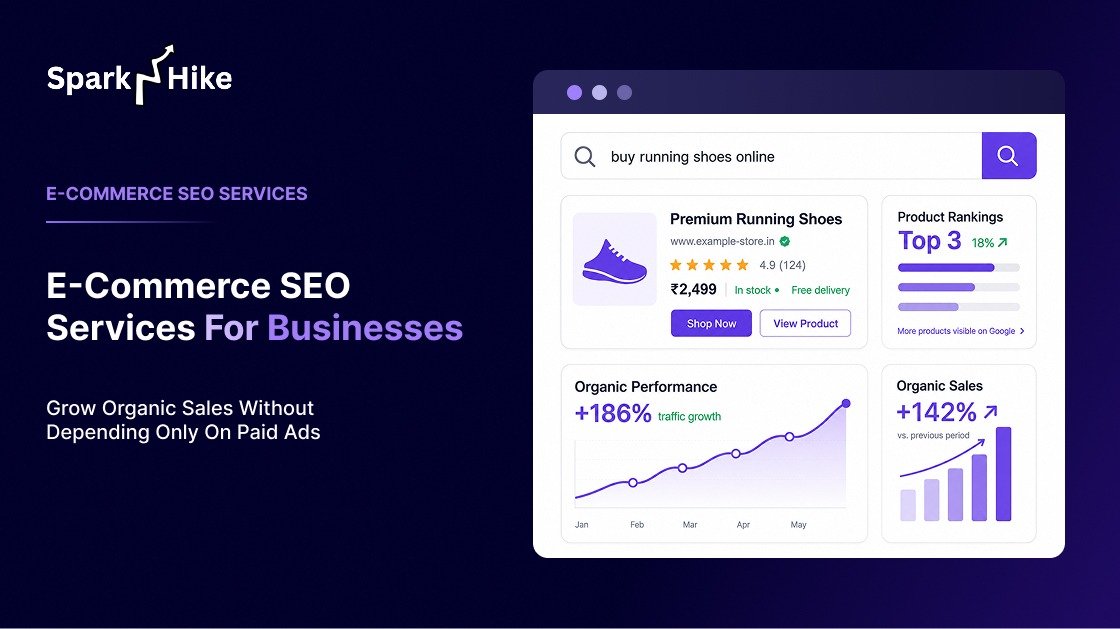
For many online stores, paid advertising becomes the fastest route to sales. Google Ads, Meta Ads and marketplace promotions can bring customers quickly, but there is one obvious limitation: when the advertising budget stops, much of that traffic stops with it.
That is why more ecommerce businesses are looking beyond paid acquisition and investing in ecommerce SEO services to build a stronger organic sales channel.
For online stores in India, the opportunity is particularly valuable. Customers search Google every day for products, categories, comparisons and buying advice before making a purchase. Appearing during those searches can bring qualified visitors to an ecommerce website without paying for every click.
At SparknHike, we approach ecommerce SEO around that business objective: helping online stores improve product and category visibility, attract relevant organic traffic and create a more sustainable path to sales.
Why Depending Only on Paid Ads Can Limit Ecommerce Growth
Paid advertising is valuable for ecommerce businesses. It can generate immediate visibility, support product launches and put an offer in front of customers quickly.
The problem begins when paid campaigns become the only dependable source of website traffic.
An online store may find itself increasing its advertising budget simply to maintain the same sales volume. Competitive keywords can become expensive, acquisition costs may increase, and reducing campaign spend can immediately affect traffic.
That does not mean ecommerce brands should stop advertising.
A healthier strategy is to use paid campaigns for immediate customer acquisition while building organic visibility alongside them.
Professional ecommerce SEO services can help an online store attract customers who are already searching for relevant products through Google. Over time, this creates another acquisition channel instead of making every potential sale dependent on paid clicks.
For businesses that also need immediate campaign-driven growth, SparknHike provides dedicated PPC Services alongside organic search strategies.
What Do Ecommerce SEO Services Actually Do for an Online Store?
Ecommerce SEO is different from optimising a small business website with ten or twenty pages.
An online store can contain hundreds or thousands of URLs across products, categories, filters, brands, collections and informational content. Search engines need to understand which pages matter, what each page represents and which searches those pages should appear for.
A structured ecommerce SEO strategy therefore looks beyond simply inserting keywords into product descriptions.
It can involve:
- Product and category keyword targeting
- Website architecture and internal linking
- Product page optimisation
- Category page optimisation
- Technical SEO
- Duplicate content management
- Crawl and indexation improvements
- Content development
- Structured product information
- Organic conversion opportunities
SparknHike’s broader SEO Services combine these areas into strategies built around relevant visibility rather than rankings that have little connection to commercial intent.
For ecommerce businesses, the most important question is not simply “Are we getting more organic traffic?”
It is:
“Are potential customers finding our products when they are actively searching for something we sell?”
Product Pages Need to Rank for Buying-Intent Searches
Product pages are where ecommerce SEO becomes closely connected to revenue.
Someone searching for:
buy men’s leather wallet online
wireless headphones under ₹5,000
organic face serum for oily skin
or
women’s running shoes online
is showing much stronger purchasing intent than someone searching for a broad informational term.
Good product page SEO helps search engines understand what a product is, who it is relevant to and which searches the page should potentially appear for.
That may involve improving product titles, descriptions, headings, URLs, images, internal links and structured data while making sure the page remains useful for actual customers.
Copying a manufacturer’s description across hundreds of products usually does little to differentiate an online store.
Useful product pages should answer the questions a customer is likely to have before buying.
That makes SEO for ecommerce websites as much about customer understanding as keyword optimisation.
Category Pages Can Become Powerful Organic Landing Pages
Individual products matter, but category pages can often target broader commercial searches.
Consider an ecommerce store selling footwear.
A single product may rank for a very specific model, but categories such as:
Men’s Running Shoes
Women’s Sports Shoes
Leather Formal Shoes
or
Walking Shoes
can match much wider groups of searches.
A well-structured category page helps customers discover multiple relevant products while giving search engines a clear page to associate with broader commercial intent.
This is why effective ecommerce website SEO should not treat category pages as simple grids containing dozens of products and nothing else.
Category structure, headings, useful content, filters, internal linking and metadata all need to work together.
For large online stores, improving category visibility can become one of the most important parts of an overall ecommerce SEO strategy.
Technical SEO Becomes More Important as an Ecommerce Website Grows
Technical problems can multiply quickly on ecommerce websites.
A store with hundreds of products can generate many additional URLs through filters, sorting options, pagination, search parameters and product variations.
Without proper control, search engines may spend time crawling low-value URLs while important category and product pages receive less attention.
Common ecommerce technical issues can include:
- Duplicate or near-duplicate URLs
- Incorrect canonical tags
- Poor internal linking
- Products that cannot be crawled properly
- Indexation of unnecessary filter pages
- Slow loading speeds
- Mobile usability issues
- Broken product links
- Redirect problems
- Poorly structured URLs
- Out-of-stock page handling
- Missing or incorrect structured data
This is where ecommerce technical SEO becomes essential.
SparknHike’s Technical SEO Services focus on strengthening the underlying website structure so important pages can be crawled, understood and indexed more effectively.
For ecommerce stores, fixing technical problems can sometimes create more value than publishing another twenty generic blog posts.
Good Ecommerce Content Should Help Customers Make Buying Decisions
Content plays an important role in ecommerce SEO, but an online store does not need hundreds of articles created only to target keywords.
The strongest ecommerce content helps customers move closer to a buying decision.
That can include:
Buying guides that help customers choose between products.
Comparison content that explains meaningful differences.
Category content that helps users understand available options.
FAQs that answer common purchase questions.
Product descriptions that communicate genuine benefits and specifications.
Informational blogs that capture customers earlier in their research journey.
For example, a skincare ecommerce business may benefit from content answering:
Which skincare products are suitable for oily skin?
The article can educate the customer while naturally introducing relevant products or categories.
That is far more useful than publishing unrelated content simply to increase the number of indexed pages.
SparknHike’s Content Writing Services can support ecommerce brands with search-focused content designed around customer questions, products and commercial opportunities.
Ecommerce Search Is Expanding Beyond Traditional Google Results
Search behaviour is changing.
Customers are increasingly comfortable asking complete questions instead of typing only short keywords.
Someone may search:
Which laptop is suitable for video editing under ₹80,000?
or:
What type of running shoes should I buy for daily jogging?
These conversational searches create opportunities beyond traditional keyword optimisation.
SparknHike also provides Answer Engine Optimization to help businesses structure useful information around questions people are asking.
Our Generative Engine Optimization Services focus on strengthening how businesses, products and content can be understood across emerging AI-driven search experiences.
AEO and GEO do not replace ecommerce SEO services.
They expand the search strategy.
For ecommerce brands, the foundation still needs to include strong product information, category structure, technical performance, useful content and trustworthy business signals.
Shopify and WooCommerce Stores Need Platform-Specific SEO
Shopify and WooCommerce make it easier for businesses to operate online stores, but neither platform automatically guarantees strong search visibility.
A Shopify store may need attention around collection structures, product URLs, duplicate content, themes and performance.
WooCommerce websites may face different challenges depending on WordPress configuration, plugins, hosting, themes and site architecture.
That means Shopify SEO and WooCommerce SEO should still be approached according to the actual website rather than applying one standard checklist to every store.
The platform provides the infrastructure.
The SEO strategy determines how effectively products, categories and content can compete in search.
Ecommerce SEO in India Needs to Reflect How Indian Customers Search
An ecommerce brand selling in India competes in a diverse and increasingly crowded digital market.
Customers often compare products across Google, marketplaces, brand websites and social platforms before making a decision.
Searches can also become very specific around:
price ranges
product features
delivery
brands
use cases
materials
sizes
locations
comparisons
For an ecommerce business targeting customers across Delhi NCR, Mumbai, Bengaluru, Hyderabad, Pune, Chennai or throughout India, simply targeting broad national keywords may not always be enough.
Effective ecommerce SEO services in India should identify where search demand overlaps with the products a business can realistically compete for.
That means finding the right balance between:
high-volume category searches,
specific buying-intent keywords,
product searches,
informational searches,
and long-tail queries with clear commercial relevance.
A good ecommerce SEO company in India should therefore build the strategy around the store’s products, margins, competition and customer journey rather than choosing keywords based only on search volume.
SEO and Paid Advertising Work Better Together
The strongest ecommerce growth strategy does not necessarily choose between SEO and paid advertising.
Each channel serves a different purpose.
Paid campaigns can help a business generate immediate traffic, test offers and promote priority products.
SEO can strengthen long-term product and category visibility.
Content can reach customers who are still researching.
Remarketing can bring previous visitors back.
Together, these channels can create multiple opportunities to reach the same potential customer at different stages of their buying journey.
For example, an ecommerce business could use Google Ads to drive immediate sales while its ecommerce SEO strategy works on improving organic rankings for important categories.
As those organic positions strengthen, the business can begin generating additional traffic without paying for every individual visit.
That is a more balanced acquisition strategy than expecting one marketing channel to do everything.
When Should an Online Store Invest in Ecommerce SEO Services?
SEO becomes particularly relevant when an ecommerce business wants growth that extends beyond short-term campaigns.
An online store may be ready for professional ecommerce SEO services when it has a growing product catalogue but limited organic traffic, relies heavily on paid advertising, struggles to rank category pages, has technical SEO problems or wants to build a stronger long-term acquisition channel.
It can also make sense before expanding into new product categories.
Building the correct website structure and search strategy early is often easier than fixing hundreds of poorly organised pages later.
SEO should therefore not be viewed only as something a business starts after traffic drops.
For ecommerce brands with long-term growth plans, it can become part of the website’s foundation.
Why Choose SparknHike for Ecommerce SEO?
Successful ecommerce SEO involves more than adding keywords to product pages.
Technical performance, product architecture, search intent, content, user experience and marketing all influence how effectively an online store can attract customers.
SparknHike takes a more connected approach.
Our ecommerce SEO services can combine:
E-commerce SEO Services for product and category visibility
Technical SEO for stronger website foundations
Content Writing for useful search-focused content
Answer Engine Optimization for answer-driven searches
Generative Engine Optimization for emerging AI search experiences
PPC Services for immediate paid acquisition
and broader Digital Marketing Services when an ecommerce business needs multiple growth channels working together.
Rather than treating rankings as the final objective, we look at how organic visibility can support meaningful product discovery, qualified traffic and online sales.
Build an Organic Sales Channel Alongside Paid Advertising
Paid advertising can remain an important part of ecommerce growth.
The goal of SEO is not necessarily to replace it.
The bigger opportunity is to stop making every website visit and every potential sale dependent on paid media.
A strong organic presence allows customers to discover products through Google while they are researching, comparing and preparing to purchase.
For online stores in India, professionally planned ecommerce SEO services can help strengthen that visibility across products, categories and customer searches while creating a more sustainable acquisition channel over time.
If your ecommerce store is generating sales through advertising but organic search is still contributing very little, there may be significant room for growth.
Connect with SparknHike to discuss your ecommerce website, current organic visibility and the search opportunities worth pursuing.